
Commercial Dodgeball Arena for Trampoline Parks
An indoor dodgeball arena is a walled court on a trampoline floor, where two teams throw soft foam balls and every step rebounds into a jump. We build each court as a zone inside an FEC or a trampoline park, sized to your ceiling and walkway, and ship it direct from our own factory in Wenzhou.

Trampoline dodgeball court with padded centre divider and full-height side netting.
What a Commercial Dodgeball Arena Is
Against a flat gymnasium court, a bounce floor roughly doubles the space a player can move through, which is why the format earns its keep in a venue that charges by the hour. As a professional trampoline dodgeball supplier we build each dodgeball court for sale as a zone inside an FEC or a trampoline park, sized to your ceiling and walkway.
Most operators run the same dodgeball zone three ways in the same week, which is usually the quickest way to lift revenue per square metre:
Walk-in groups rotate through in short matches, so the court earns by the hour.
Booked groups take the whole court, with the party room and entry desk you already run next door.
A scoreboard and a fixed weekly schedule turn the quiet evenings into repeat bookings.
Order direct and you buy from the factory, with no middleman between the order and the production line. We also supply distributors, resellers and partners who carry the NinescapeLand brand in their own markets.
Dodgeball Court Dimensions and Layout
Court size is the first thing to settle. It decides how many players fit, how many matches run per hour, and whether the zone fits your floor plate at all. The three configurations below cover almost every build we quote. Anything between or beyond them is built to your floor plan, and our custom range runs up to 50,000㎡ of park floor. Court lines follow the 18 × 9 m convention used by most national dodgeball federations, so a 6v6 build can host sanctioned fixtures.
Totals assume a 2 m safety zone on all four sides. On a tight site we work to 1.5 m and the footprint drops with it. Netting runs 3.5 m on the long sides; a closed roof is optional and adds roughly 10–15% to the netting line.
| Configuration | Playing court | Total footprint incl. 2 m safety zone | Players on court | Ball count |
|---|---|---|---|---|
| 3v3 mini arena | 10 × 5 m (50㎡) | 14 × 9 m ≈ 126㎡ | 6 | 6–8 |
| 6v6 standard court | 18 × 9 m (162㎡) | 22 × 13 m ≈ 286㎡ | 12 | 10–12 |
| 8v8 large court | 24 × 12 m (288㎡) | 28 × 16 m ≈ 448㎡ | 16 | 12–16 |
Netting runs 3.5 m. Underneath, a trampoline floor wants roughly 4.5 m clear to the lowest beam or duct. That is a working figure, and we confirm it against your ceiling, columns and sprinkler drops before quoting.
Rectangles are cheapest. An L-shaped or column-broken space can still work, but the safety zone has to stay inside the netting, so playable area shrinks.
Send a floor plan or a photo of the empty space and we return a to-scale layout with the court, walkway, spectator rail and entry gate marked.
What Drives the Cost of a Dodgeball Arena
There is no single price per square metre. Two courts of the same size can differ by 40% on netting, padding and deck. These are the four lines that move the number. For scale, our complete trampoline park packages start at around $30,000. A dodgeball court is one zone inside that kind of park, so a single-court order lands well below a full-park budget.
We price by zone, not by lump sum: frame, beds, padding, netting, balls, deck, freight and installation are listed separately. Every line is visible before you commit, so you can compare a competitor quote line by line. An 8v8 court carries almost six times the bed area of a 3v3 mini arena, and bed area dominates the quote. Most first builds sit at 6v6, because it is the smallest court that supports league play.
| Cost driver | What changes it | Effect on the quote |
|---|---|---|
| Trampoline bed area | 3v3, 6v6 or 8v8 court footprint | Largest single line; scales almost linearly with court size |
| Netting and roof | 3.5 m side netting vs fully enclosed cage | Enclosure adds 10–15%; needed in shared halls and mezzanine sites |
| Padding scope | Posts only vs full perimeter and gate jambs | Small in money, decisive in inspection outcomes |
| Deck and access | Referee walkway, spectator rail, stair or ramp | Site-specific; usually the difference between two quotes for the same court |
What the Arena Package Includes
A dodgeball court is a system, not a trampoline bed with a net around it. Below is what ships in a standard package, so you can see what a competing quote may have left out.
Galvanised steel tube, bolted rather than welded on site, with the tube gauge specified to the court span and shown on the frame drawing.
Bed-to-bed spring layout with no dead strip at the joins, so the rebound is even across the whole court instead of only in the middle.
Low, impact-absorbing barrier that separates the two halves and keeps a sightline open for parents and referees on the walkway.
3.5 m knotted nylon with a 50 mm mesh, tensioned on the frame. Replacement panels are sold as single sections, not whole walls.
PVC-covered foam on every exposed tube, spring cover and gate jamb. This is the line item that decides whether your inspection passes.
6.5–7 inch no-sting foam balls, 8–16 per court depending on size, plus a mesh storage trolley at the entry.
Non-trampoline perimeter deck for staff, waiting players and spectators, at the same height as the court edge.
LED scoreboard and shot clock with a control box at the walkway. Worth adding if you plan to sell league slots.
Court Layouts and 3D Designs
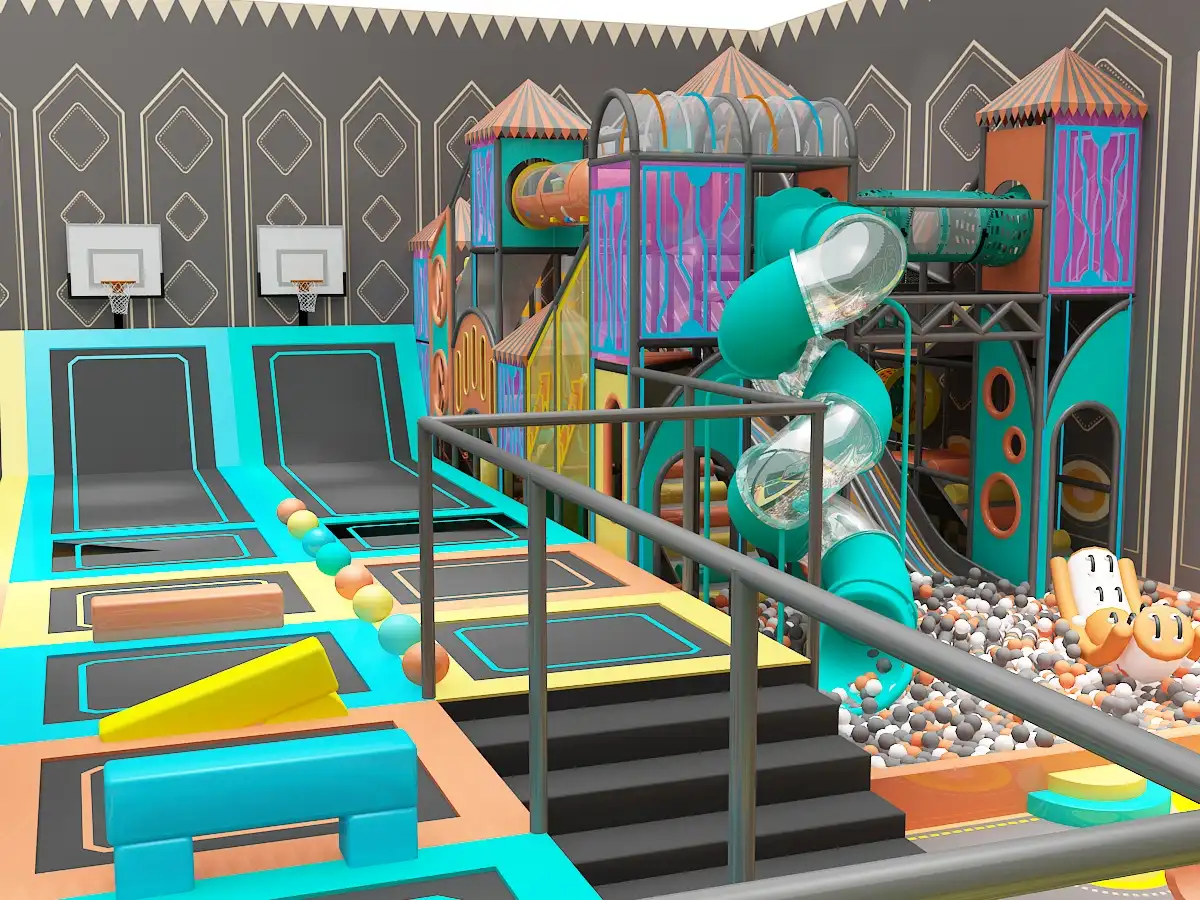
Dodgeball courts are almost never a standalone building. They sit inside a park, next to a free jump floor, a foam pit or a ninja course. The layout decides how the zone reads from the entrance and how the queues flow. Below are 3D layouts we have produced for parks that include a dodgeball zone. All six are design renders produced in-house, not photographs of built sites.
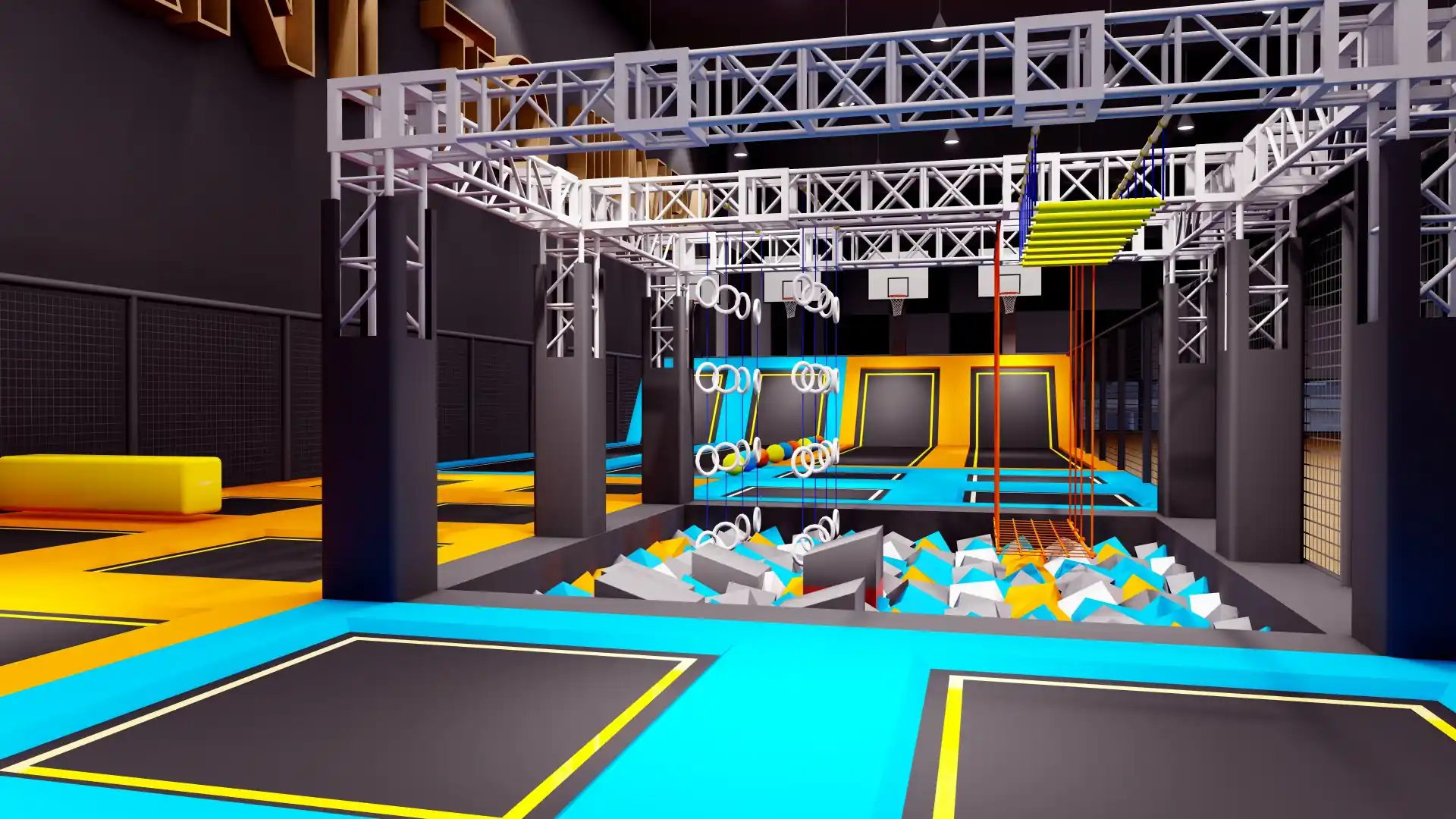 Twin courts, open-plan parkDodgeball floor framed by basketball and foam pit zones, sharing one walkway.
 Wall-to-wall jump floorBed-to-bed surface with a themed colour scheme; dodgeball sits at the far end.
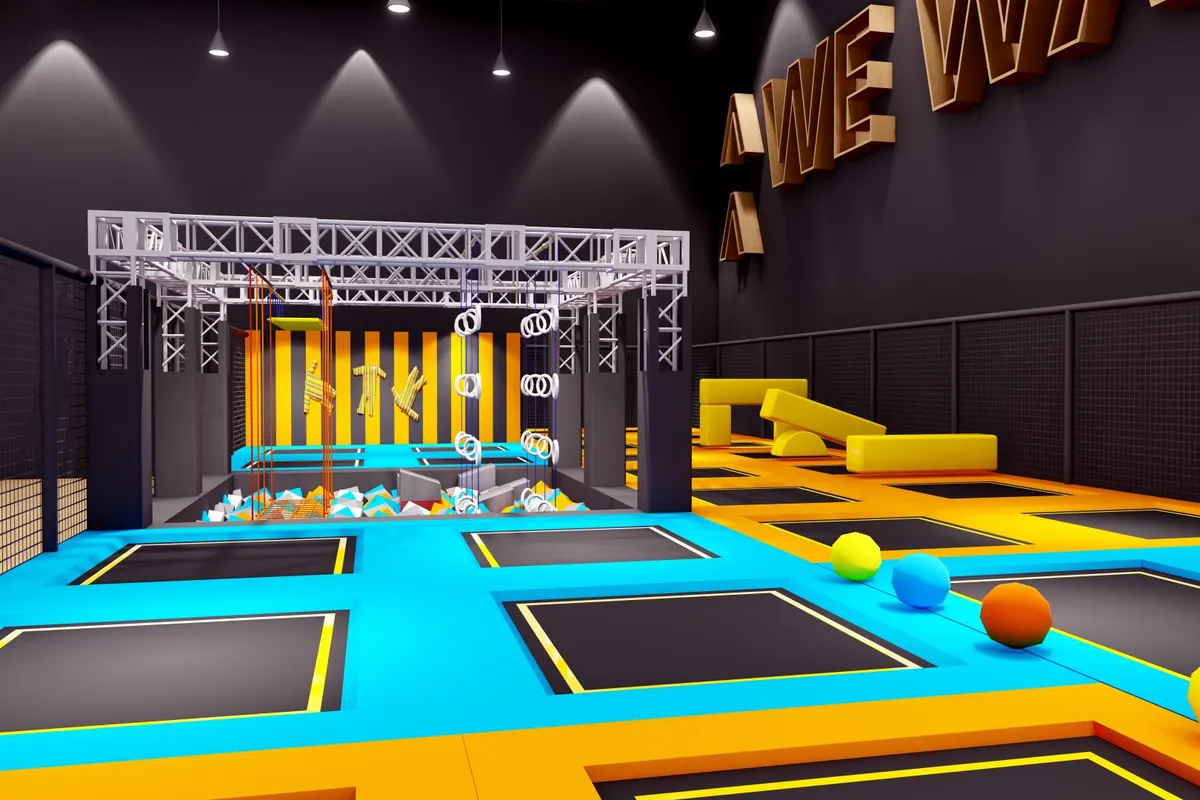 Dodgeball beside a ninja courseMixed-zone layout for venues that want a competitive corner, not a whole sport floor.
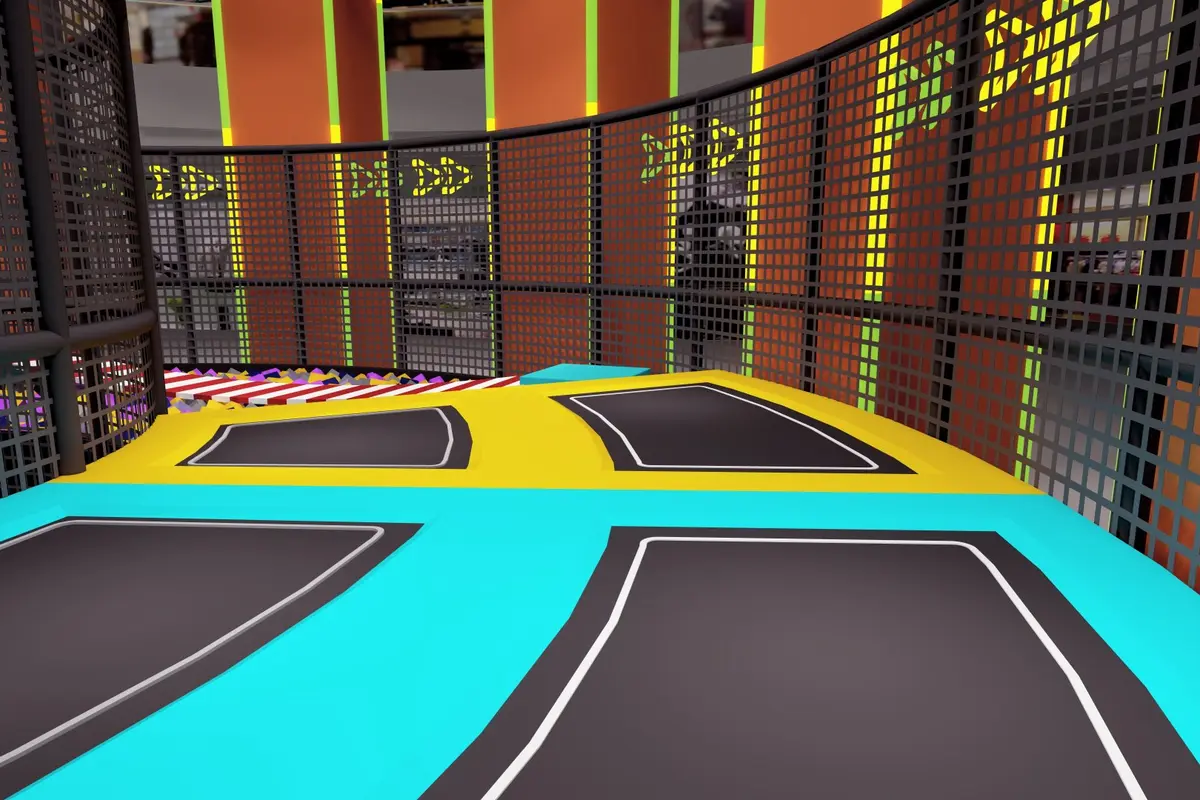 Compact mall unitA single court fitted into a retail footprint, with the safety zone kept inside the netting.
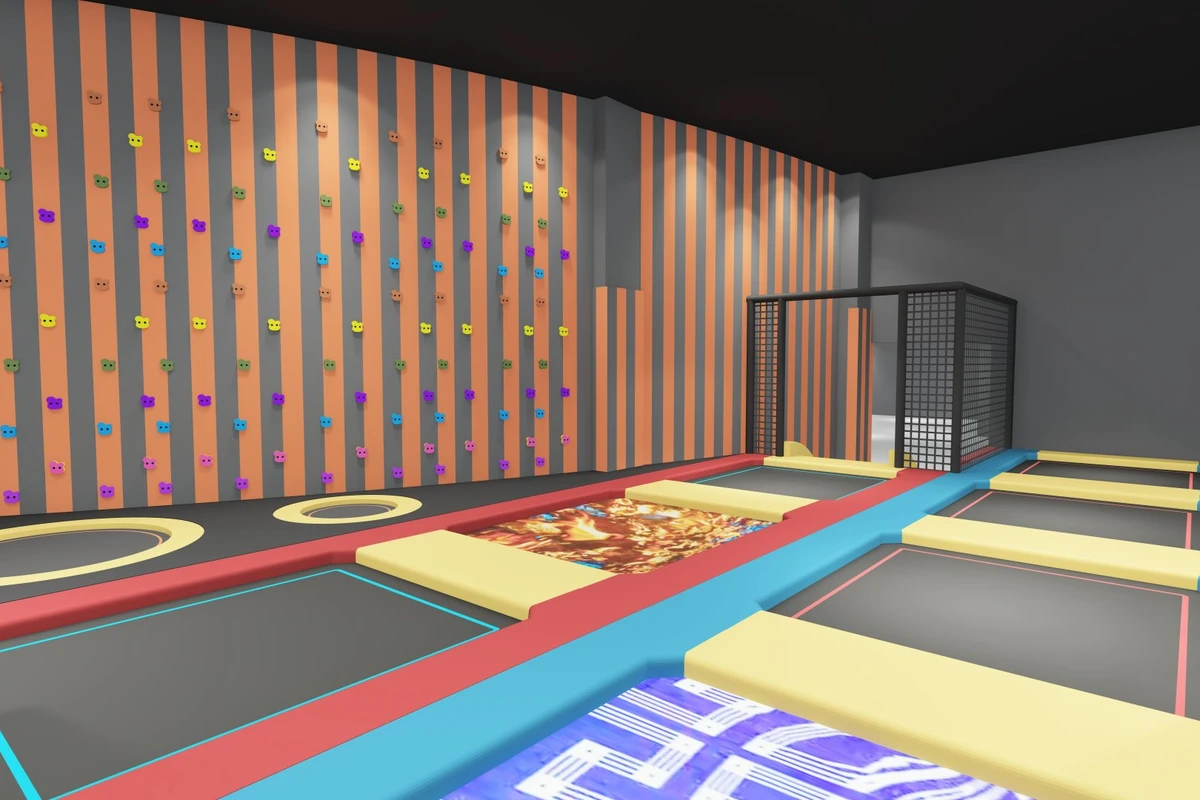 Climbing wall plus courtTwo anchor attractions at opposite ends, so the floor between them stays circulation.
 Full floor planOverhead view of a complete park: court, walkway, spectator rail and party rooms.
Click any image to open it full size.
Netting, Padding and Frame Specifications
If the arena has to pass an inspection, an insurer review or a landlord fit-out sign-off, this is the section your consultant will ask for. Frames are tested and documented per order, not per company. You receive the certificate pack with the shipping documents, which is what an inspector or insurer usually asks to see.
| Item | Specification | Why it matters |
|---|---|---|
| Frame | Galvanised steel tube, bolted joints, gauge specified to the span | Rust protection for humid or coastal venues; bolts allow re-tensioning after years of impact |
| Springs | Galvanised, 18–22 cm, individually replaceable | One broken spring does not mean a new bed |
| Netting | 3.5 m height, 50 mm mesh, knotted nylon, 2 mm twine | Keeps balls in and players off the walkway without blocking the view |
| Padding | PVC over closed-cell foam, 25–40 mm | Absorbs impact against posts and gates, the usual source of inspection findings |
| Ball specification | 6.5–7 inch no-sting foam, 120–140 g | Light enough for a 7-year-old, stable enough to throw straight |
| Load rating | Specified per bed panel | The load calculation is issued with the frame drawing, so an inspector or insurer can see the number behind the court |
Throughput: What a Court Earns Per Hour
The number that decides whether the zone pays for itself is not the ticket price. It is how many matches you can turn over in an hour. A 6v6 court handles 12 players per match. At six matches an hour that is up to 72 player-slots, before spectators. The same floor area as open jump holds far fewer paying guests at once.
| Session type | Match length | Court rotation | Notes |
|---|---|---|---|
| Open play | 5–7 min | 6 matches an hour on a 6v6 court | Short matches suit walk-ins; queue managed at the entry gate |
| Birthday party block | 45–60 min booked | 1 party, rotating teams inside the slot | Highest revenue per hour; usually bundled with a party room |
| League night | 2 × 20 min | 4–6 fixtures per evening | Fills weekday evenings, which are the weakest open-play hours |
| School or corporate | 60–90 min | 1 booking, 2–4 teams | Repeatable midweek revenue; needs a referee walkway and seating |
Rotation assumes one court, one referee, and a queue held at the entry gate.
Delivery, Installation and Site Readiness
- Production: 30–45 days for a standard trampoline court, longer for enclosed arenas and multi-court layouts.
- Install: 5–10 days on site for one court, up to 20 days for a multi-court build, with our own crew or a supervised local team.
- What we need from you: finished floor, power at the court edge, a 1.2 m access route for frame sections, and a ceiling drawing.
- Handover: bed tension check, padding and netting inspection, ball stock, and a maintenance sheet for your ops team.
If the arena is part of a larger build, we sequence it with the rest of the park. That way the dodgeball court is not the item holding up your opening date. See how the zone sits inside a full layout on our trampoline park equipment page, or compare it with the free jump zone, the slam dunk zone and the sky zone park.
A full park layout in 3D: dodgeball is one zone among basketball, foam pit and ninja areas, sharing the same walkway and entry.
Why choose NinescapeLand as your dodgeball arena supplier
Four things buyers check before they wire a deposit, and where we stand on each.
- One factory, one warranty. As a professional trampoline dodgeball manufacturer, we build the frame, bed, springs, padding, netting and balls in the same plant in Wenzhou. You buy from that plant, not through a dealer. If a panel fails, that is one phone call instead of two suppliers pointing at each other.
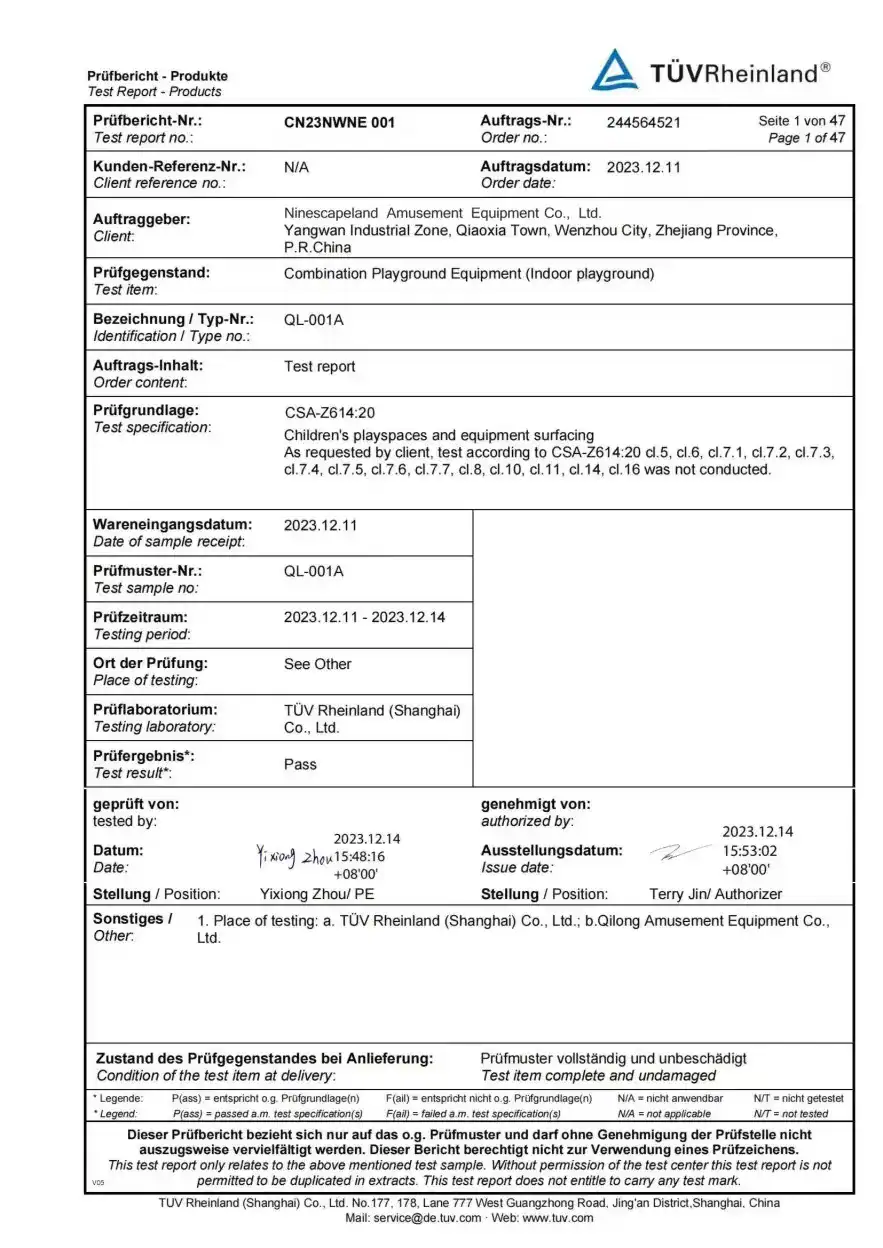
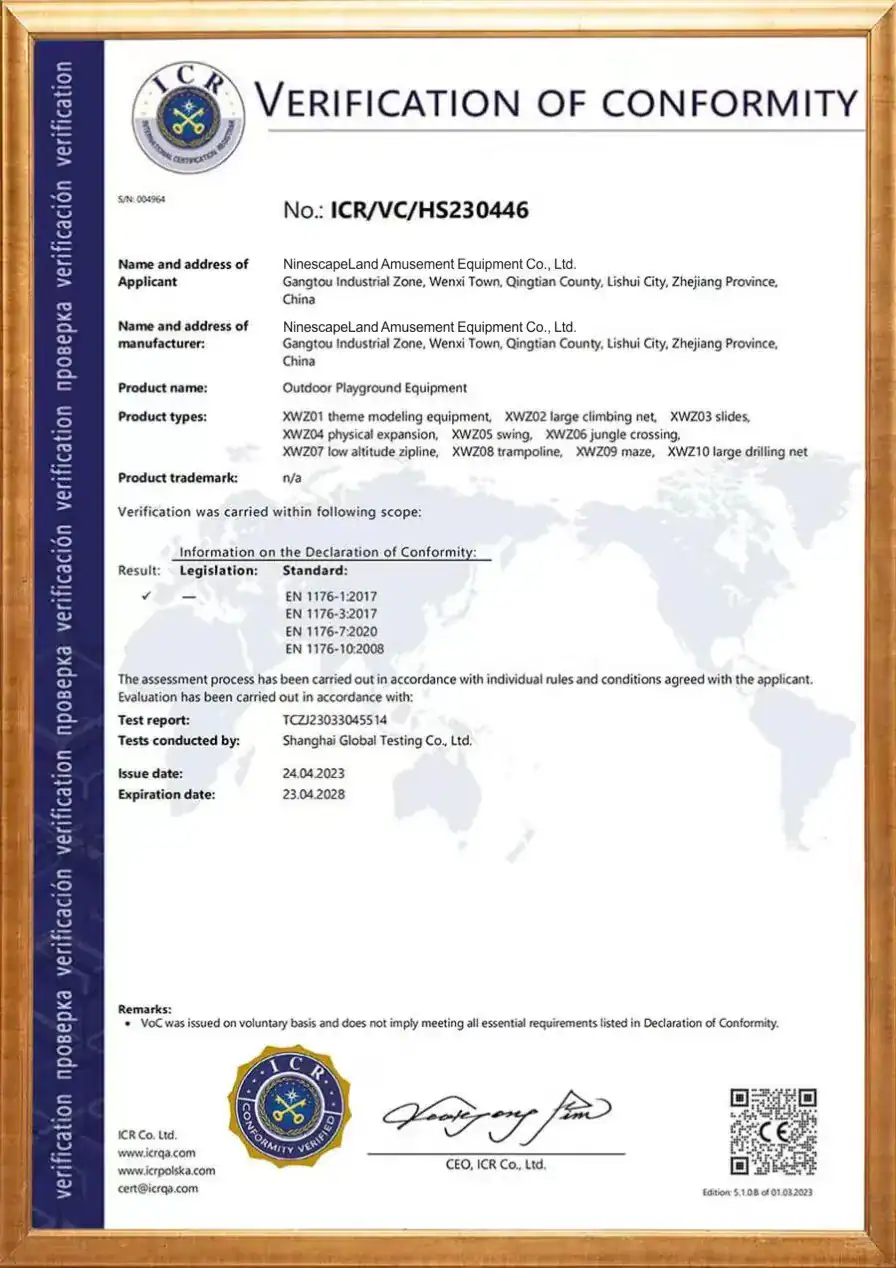
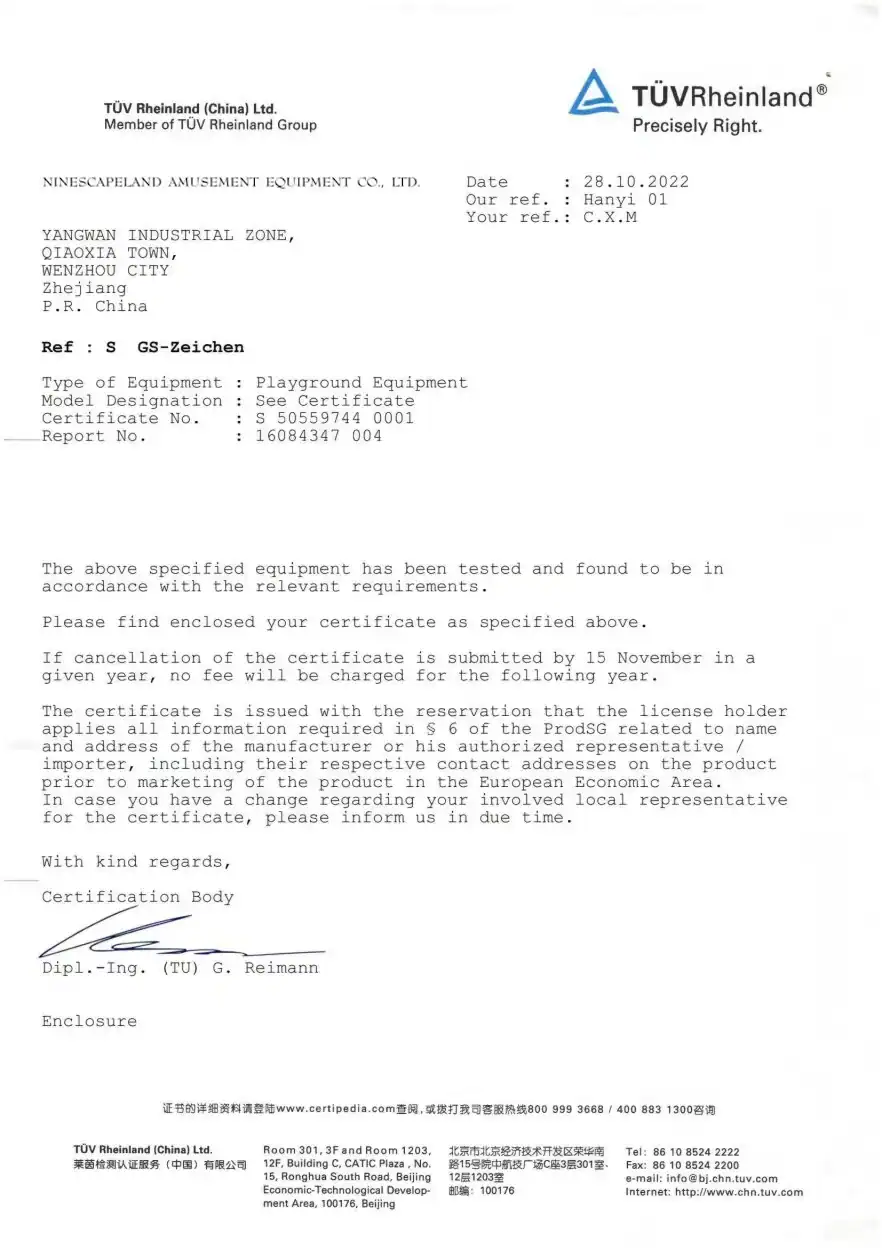
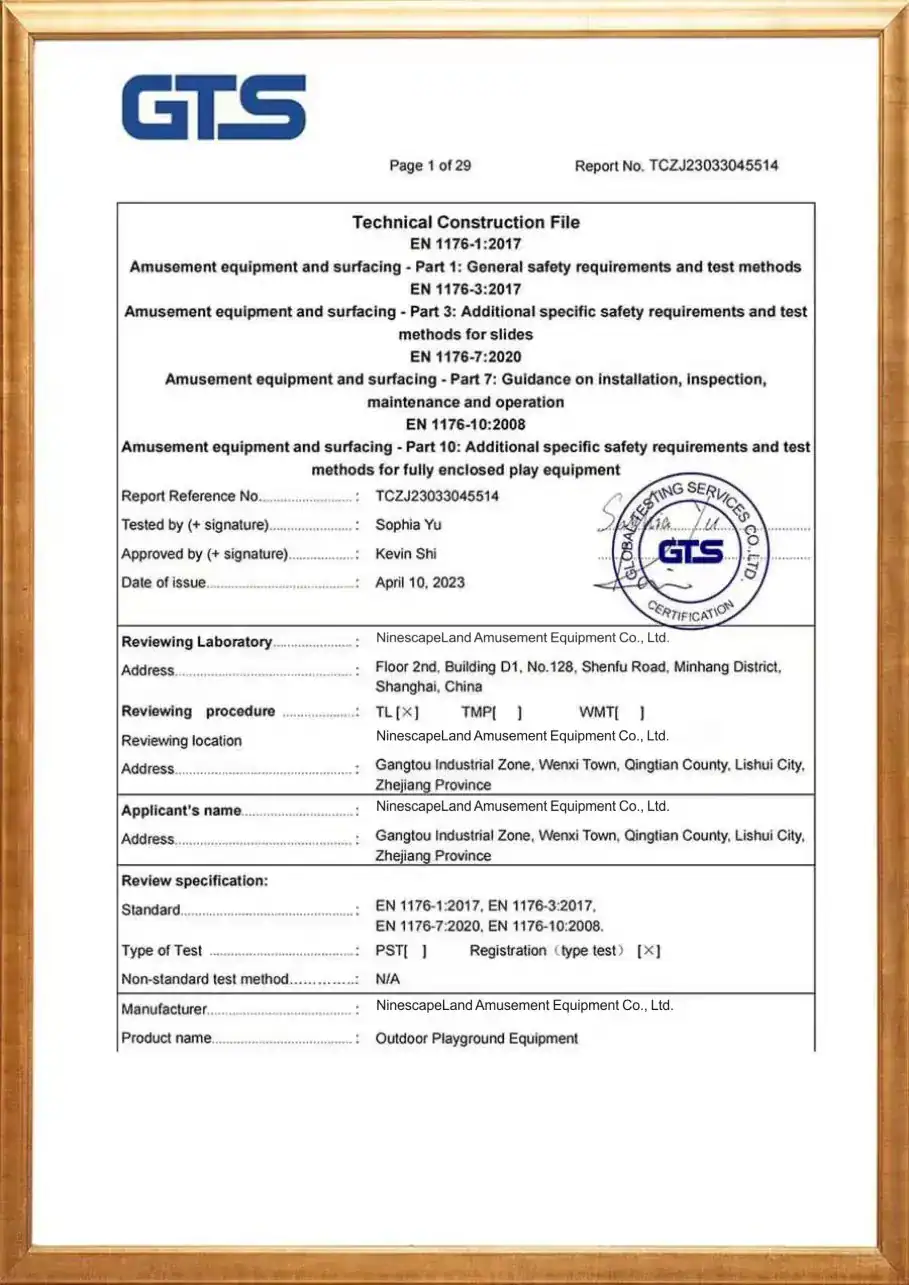
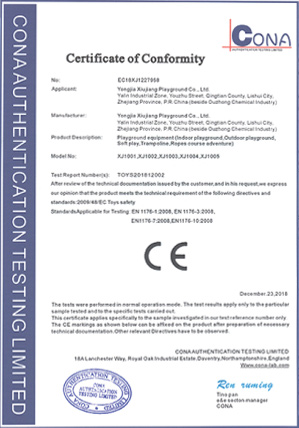
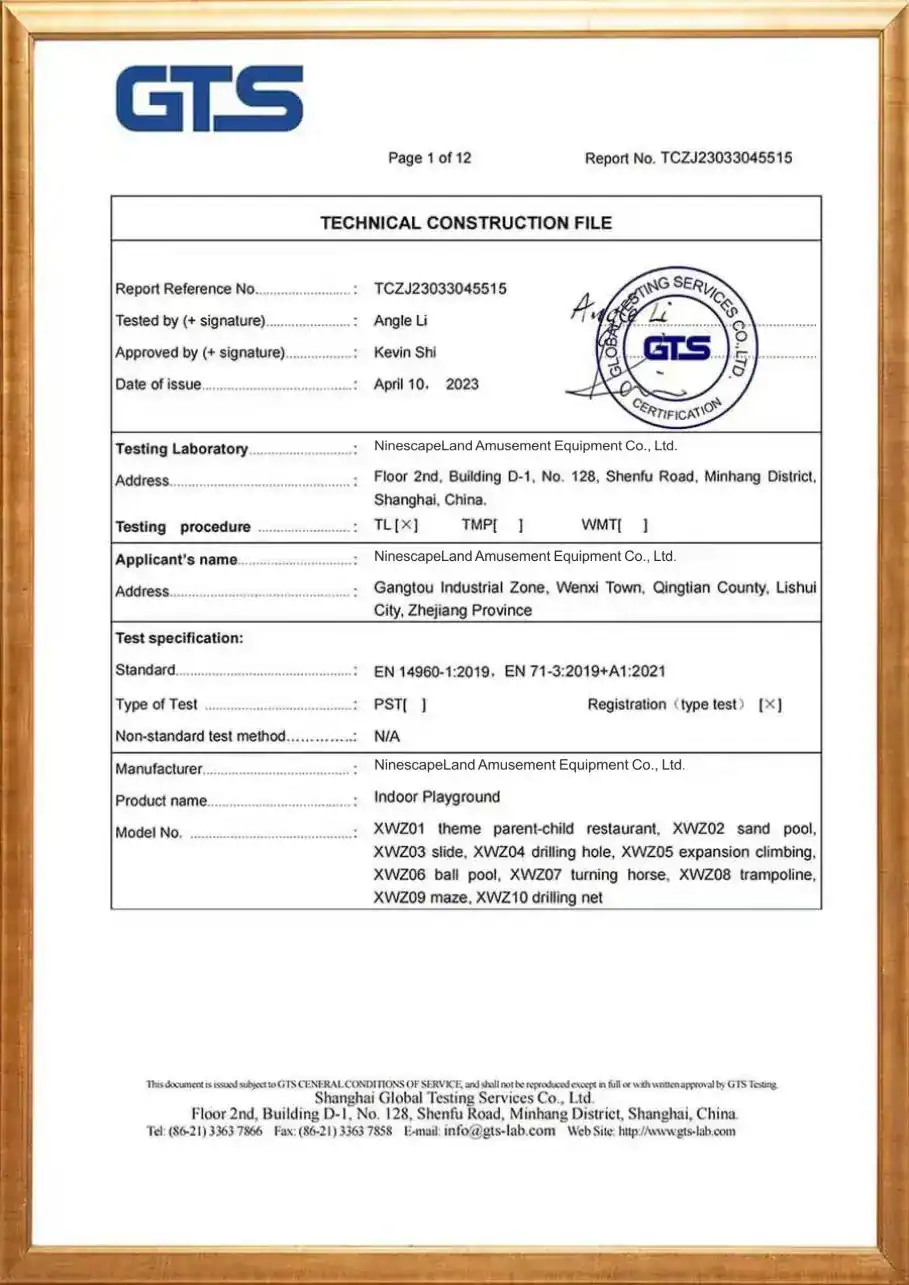
- Certification before the deposit. EN 1176, ASTM F2970, TÜV, CE and ISO documentation ships with the order. Ask for the test reports and we send them before you sign.
- Installed in 75+ countries. Our delivered builds include a 360㎡ trampoline park in the USA and an 800㎡ sports arena in Portugal, listed zone by zone with the equipment we fitted. We can also put you in touch with an operator in your region and tell you what went wrong on their build, not only what went right.
- Present after handover. Net panels, springs, padding covers and balls are sold as individual spares for the life of the court, with lifetime technical support on layout and maintenance.
Watch how one of these builds came together on site in Rio de Janeiro.
Certificates and Test Reports
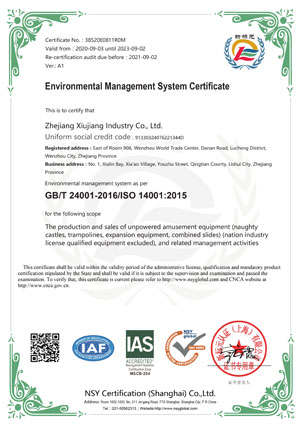
Every court ships with documentation for your inspector, landlord and insurer. Each certificate states its own scope and validity, and we send the full set before you sign. The full document set is on our certifications page; ask us which ones apply to your project.



Dodgeball Arena FAQ
What size does a commercial dodgeball arena need?
A 3v3 mini arena starts at a 10 × 5 m court, about 50㎡ of playing floor. Add the 2 m safety zone and you need roughly 126㎡. A 6v6 court is 18 × 9 m and takes about 286㎡ all in. Ceiling height matters as much as floor area. The netting itself is 3.5 m, and the trampoline floor underneath wants roughly 4.5 m clear to the lowest beam. We confirm that against your ceiling drawing.
How much does a dodgeball arena cost?
Three things move the price: court size, netting height, and whether you need a spectator deck. So we quote from your floor plan instead of publishing one number. An 8v8 court carries almost six times the bed area of a 3v3 mini arena, and that is the single biggest reason two quotes differ. The quote is itemised by zone, so you can compare it against another supplier line by line.
How many people can play at once?
Six on a 3v3 court, twelve on a 6v6, sixteen on an 8v8. Teams rotate in and out between matches, so a 6v6 court can serve up to 72 player-slots an hour in open play.
Is the floor the same as a standard trampoline zone?
Same spring and bed technology, different layout. A dodgeball court is a continuous bed-to-bed surface with a padded divider down the centre and netting on the sides. The ball stays in, and players cannot leave the court mid-match.
Is a professional trampoline dodgeball arena for sale as a single court, or only inside a full park?
Either. A single court is quoted, shipped and installed on its own, and most of our orders start that way. If you want the rest of the park as well, we quote the whole floor plan with the dodgeball court itemised separately so you can add or drop it.
Are you a dodgeball arena manufacturer or a supplier?
Both. NinescapeLand builds dodgeball arenas in its own factory in Wenzhou, China: the steel frame, the trampoline beds, the padding and the netting. We supply park operators in 75+ countries directly, so there is no dealer between you and the people who welded the frame.
Do you sell indoor dodgeball arenas wholesale to operators and resellers?
Yes. We are the factory, so wholesale pricing applies to operators adding a court to an existing park, to multi-site chains and to distributors. The same warranty and spare-part terms apply at every volume. We also back partners who sell under the NinescapeLand brand, with our logo, catalogue and specifications behind their sales.
Can you add one court to an existing park?
Yes, and it is the most common order we get. Send the current layout and we will find a position that does not cut the walkway or block an exit, then ship a court sized to that gap.
What netting and padding do you supply?
Netting is 3.5 m knotted nylon with a 50 mm mesh on all open sides. Padding is PVC-covered closed-cell foam on every exposed post, spring and gate jamb, plus a padded centre divider. Replacement net panels are sold per section.
Which standards does the equipment meet?
EN 1176 for play equipment, ASTM F2970 for trampoline courts, with TÜV Rheinland GS and CE documentation issued per order. The certificate pack ships with the equipment for inspection and insurance.
How long is delivery and installation?
30–45 days production for a standard court, then 5–10 days on site, or up to 20 days for a multi-court build. Freight is by sea container unless you are close enough for road transport. We quote both and tell you what each one costs in time.
What warranty and spare parts do you carry?
Three years on the steel frame and one year on padding and soft components, plus lifetime technical support. Springs, net panels, padding covers and balls are available as individual spares afterwards. Bed tension is checked at handover and the settings are written into the maintenance sheet.
Plan Your Dodgeball Arena
Send a floor plan, a photo of the empty space, or just the dimensions you have. You get a to-scale layout, a zone-by-zone quote and a production date, usually within one working day.
A dodgeball court is one zone. If you are planning the whole floor, start from the full trampoline park equipment range — free jump, foam pit, slam dunk, ninja and soft play, sharing walkways and one delivery schedule.
Reviewed by the NinescapeLand team, who design, build and ship these courts from our factory in Wenzhou.