
Quick Answer
If you only have thirty seconds, this is the whole guide in six lines.
| Your question | The answer |
|---|---|
| What are they? | Published technical requirements from ASTM, CEN and ISO that define how play equipment must be designed, built, installed and maintained. Not laws — but binding once a regulation, tender or insurer references them. |
| Which one applies to me? | Two systems decide most projects: ASTM (F1487 / F1918 / F2970) for the US and much of the Americas, EN (EN 1176 / EN 1177 / EN ISO 23659) for Europe and the UK. |
| What about other markets? | South America, the Middle East and Southeast Asia mostly accept an ASTM or EN report rather than requiring a separate standard. |
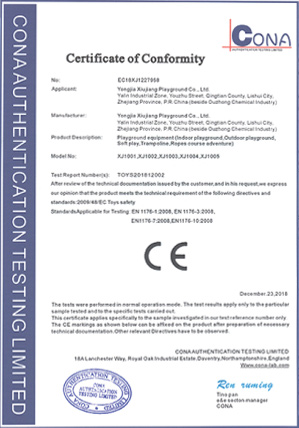
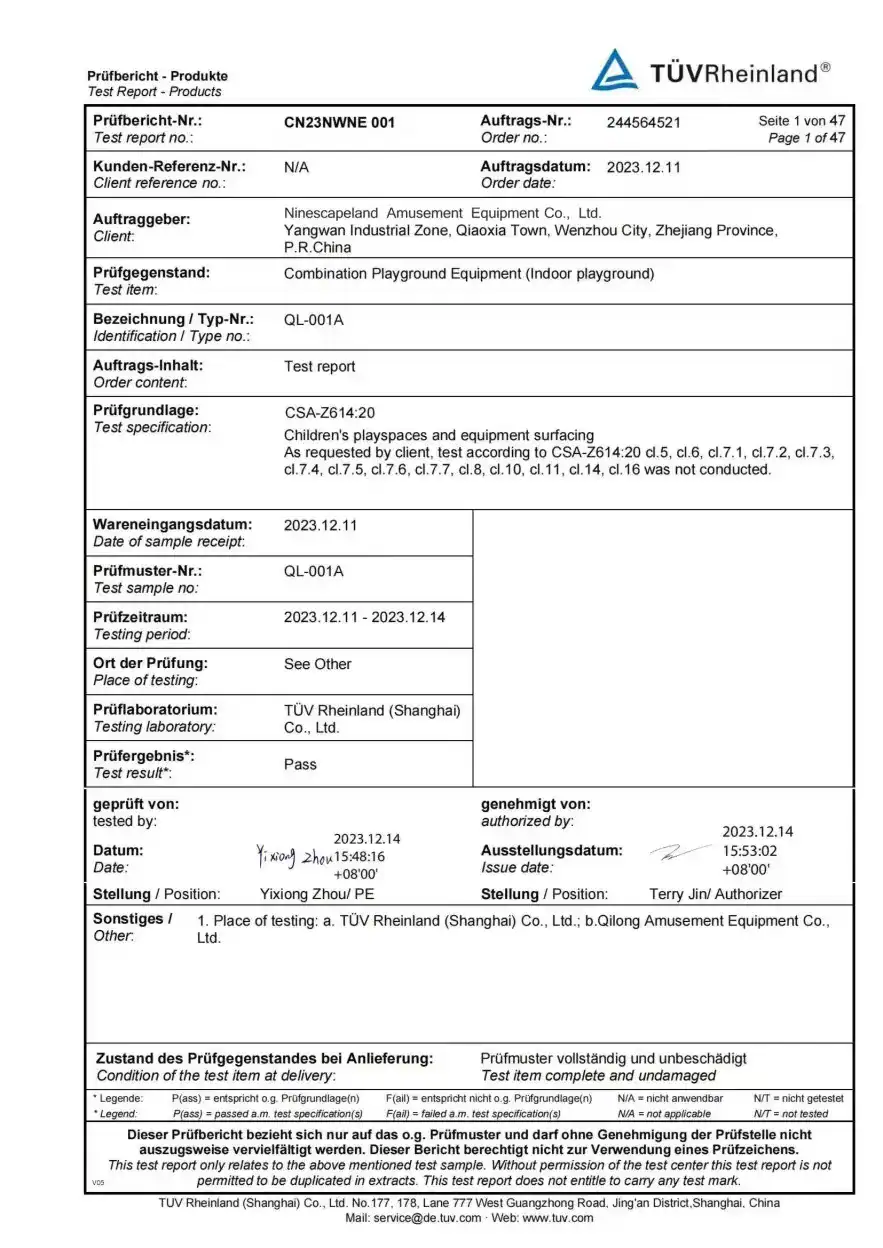
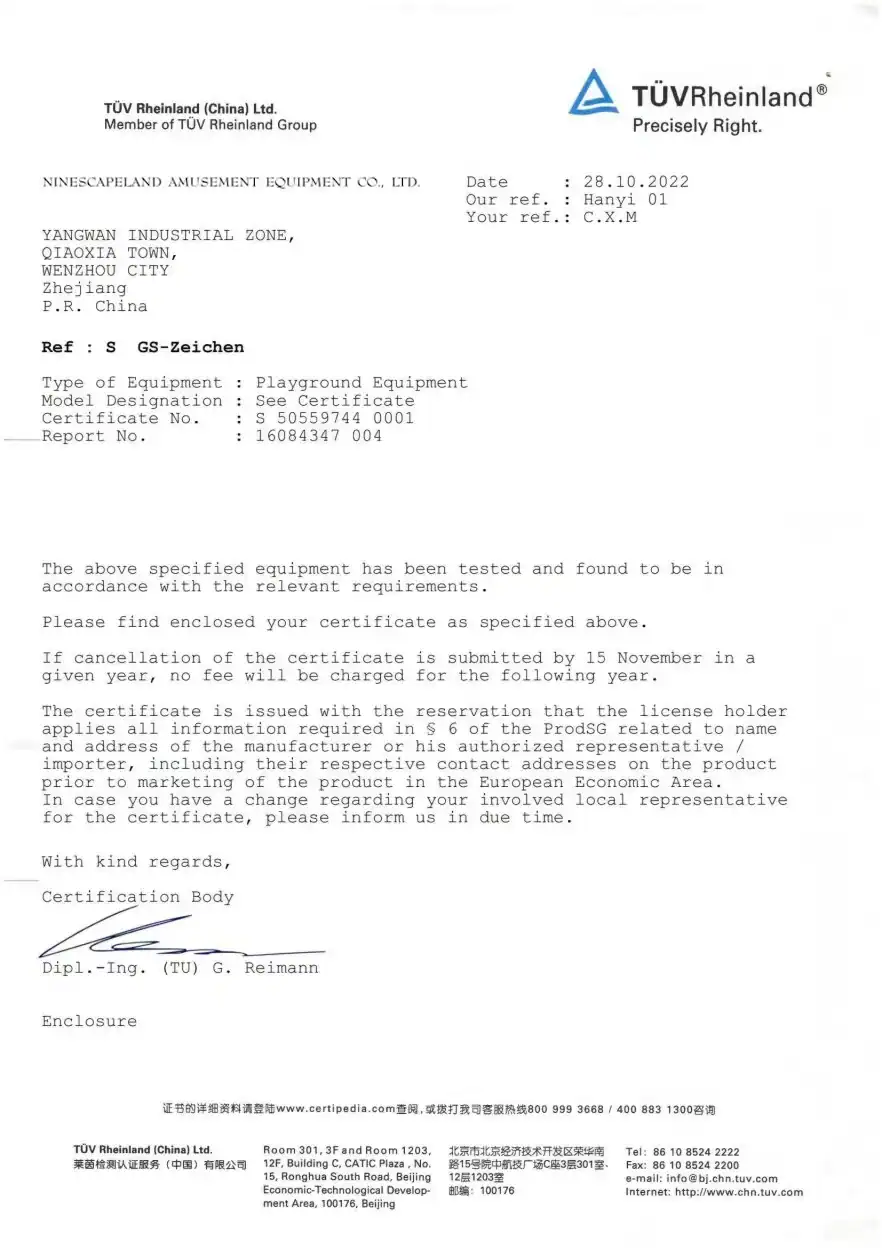
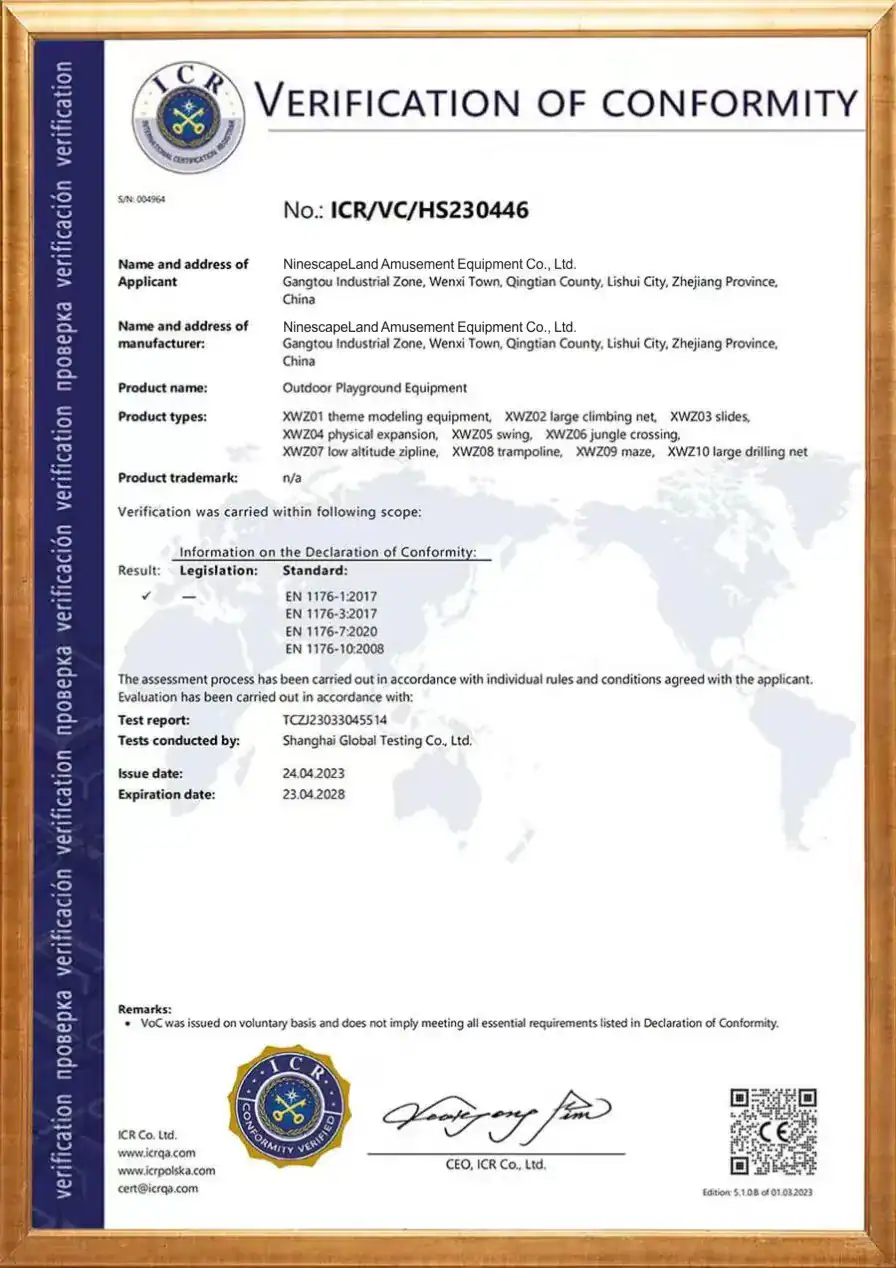
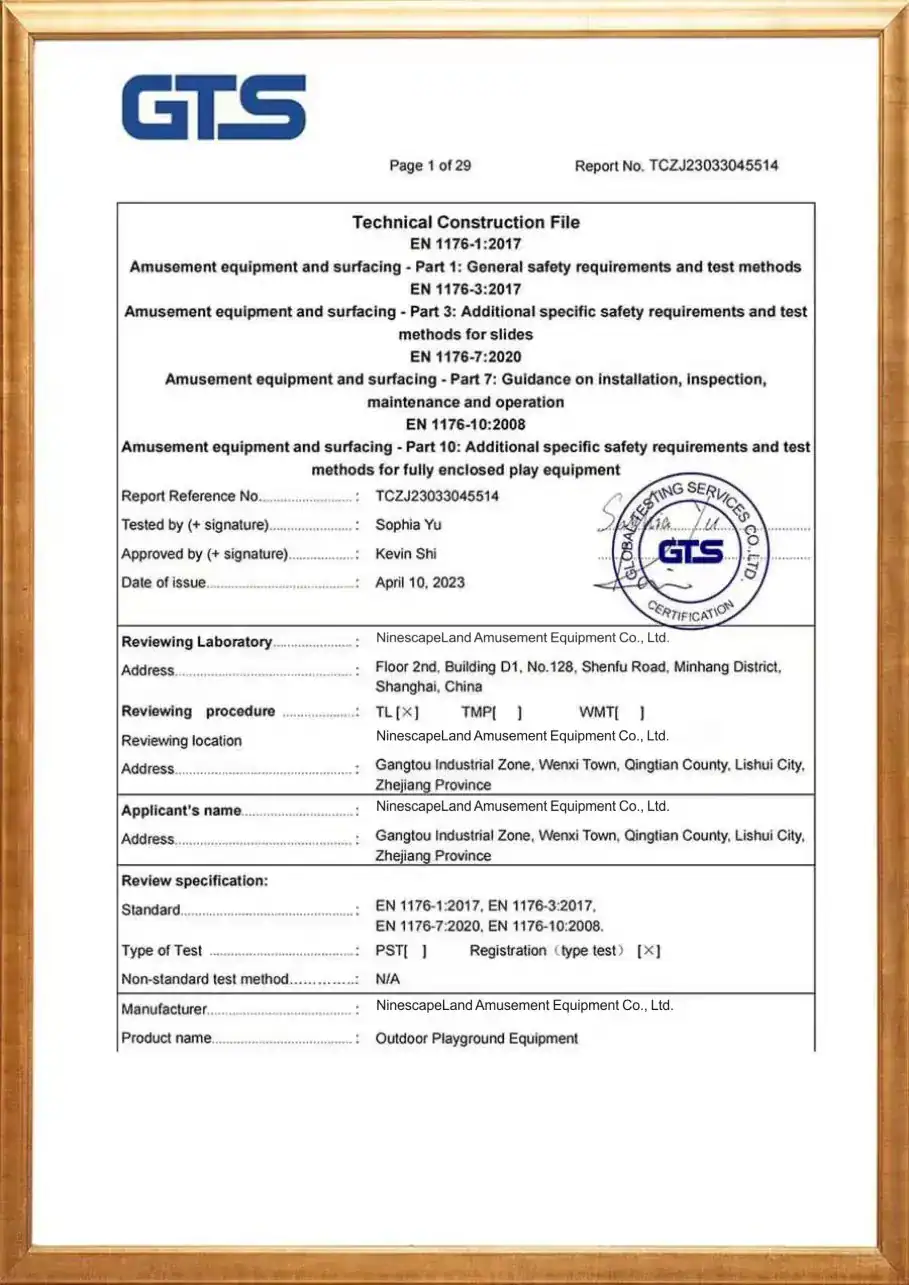
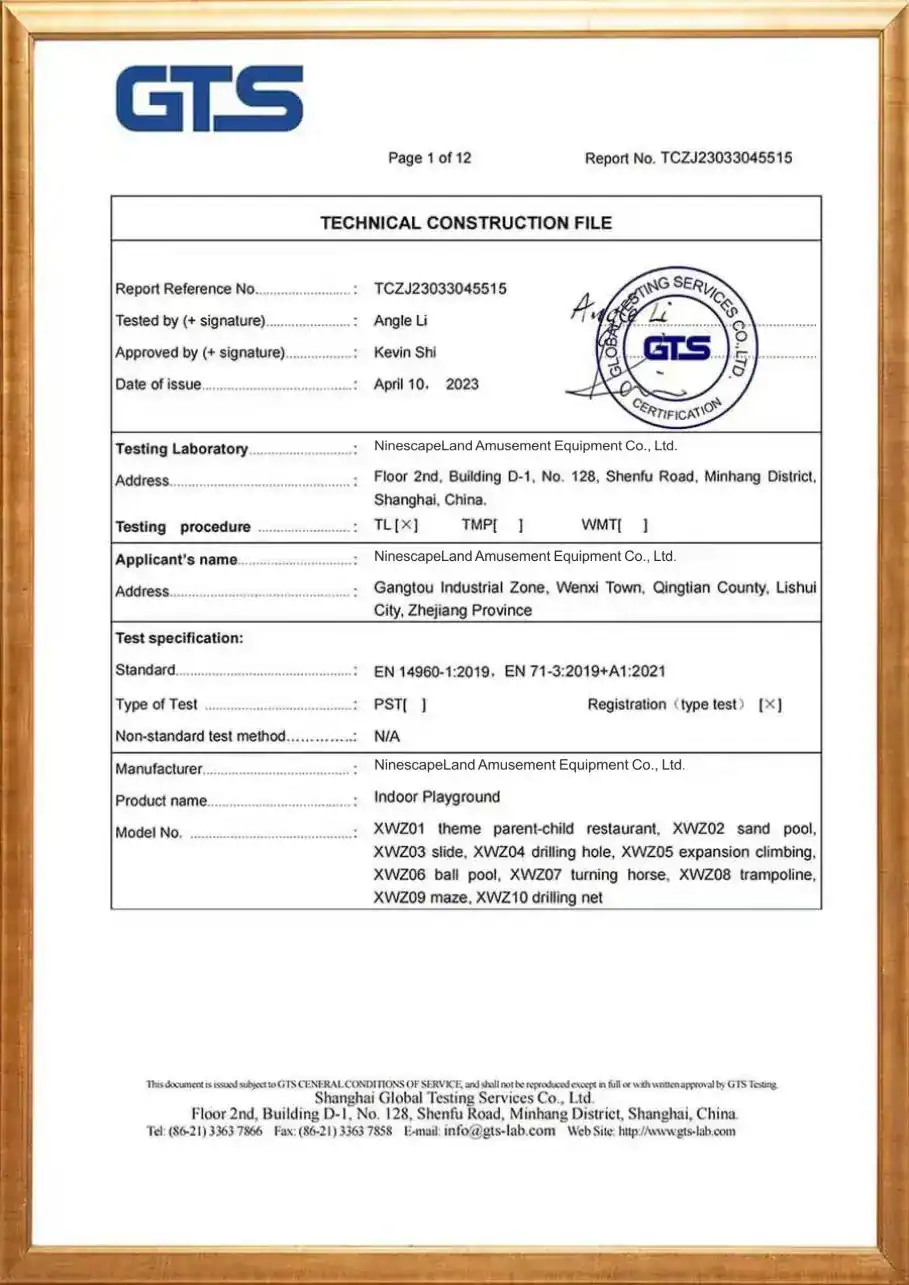
| What must I actually receive? | A Declaration of Conformity naming the standard and its edition, a third-party test report with a report number, fire test reports, and ISO system certificates. |
| What is the most common mistake? | A report covering only EN 1176-1 without the product-specific part, a model number that does not match the quotation, or a material certificate presented as a unit certificate. |
| What does it cost me to ignore it? | You lose tender eligibility, time at fire review or customs, and possibly insurance cover. The equipment can be fine and the project still fails. |
This guide to the safety standards for playground equipment maps what applies to indoor and outdoor commercial play across six systems — ASTM, EN, AS/NZS, CSA, GB and the regional frameworks used in South America and the Middle East. It is based on the reference work behind more than 1,000 delivered projects in 75+ countries. It is not legal advice; where a tender document or local regulation is stricter, that document governs.
1. What Are the Safety Standards for Playground Equipment?
Safety standards for playground equipment are published technical requirements — issued by bodies such as ASTM International, CEN and ISO — that define how play equipment must be designed, manufactured, installed and maintained so that a child can use it without foreseeable injury. They are not laws. They become binding when a regulation, a tender document, a landlord’s approval or an insurer’s underwriting policy references them, and in practice that happens on most commercial projects.
Four categories cover almost every document you will be asked for.
| Category | What it controls | Representative standards |
| Structural safety | Whether the structure collapses, traps a limb or head, or allows a fall from height | ASTM F1487, ASTM F1918, ASTM F2970; EN 1176 (-1 to -11); AS/NZS 4685; CSA Z614 |
| Surfacing and impact attenuation | How hard the landing is when a child falls | ASTM F1292; EN 1177; AS/NZS 4422 |
| Fire performance of materials | Whether soft materials spread flame | NFPA 701; UL 94; EN 13501-1; ASTM E1354 |
| Factory and system compliance | Whether the manufacturing process is under control | ISO 9001; ISO 14001; ISO 45001; CE conformity |
Three misunderstandings cause most of the problems we see.
One standard does not cover the world. ASTM and EN are separate systems with separate test methods. A report issued against one is not accepted as evidence for the other, and no mutual recognition agreement exists.
A certificate is only as broad as its scope. A material certificate proves a foam or fabric was tested. It does not prove the finished play unit meets a structural standard. Both are legitimate documents; they answer different questions.
CE is not a certificate issued by an authority. It is a declaration made by the manufacturer. Section 10 explains what that means for a buyer.
2. The Global Standards Map: Which System Applies Where
In practice, the safety standards for playground equipment that decide most projects come down to two systems — ASTM and EN — which together cover the majority of the world’s commercial play projects.
| System | Main markets | Structural standards | Surfacing / fire | System and compliance |
|---|---|---|---|---|
| EN (European) | EU 27, United Kingdom, parts of the Middle East, Africa and Southeast Asia | EN 1176 (-1 to -11) EN ISO 23659:2022 (trampoline parks) | EN 1177 / EN 13501-1 | CE Declaration of Conformity |
| ASTM (US) | United States, Canada (with CSA in parallel), specified by owners in parts of South America and the Middle East | ASTM F1487 (outdoor structures) ASTM F1918 (soft contained play) ASTM F2970-25 (trampoline courts) | ASTM F1292 / NFPA 701, UL 94, ASTM E1354 | CPSC guidance (not mandatory) |
| South America | Brazil, Chile, Colombia, Peru, Argentina and others | Mostly EN or ASTM; some countries add local rules (e.g. ABNT NBR 16071 in Brazil) | Follows the structural standard | National import and market-access rules |
| Other regions | Australia/NZ: AS/NZS 4685 and 4422 · Canada: CSA Z614 · China: GB/T 27689 and GB 8624 | Technically close to ASTM and EN in most clauses | — | National market access |
Two consequences follow from this table.
The regional systems — AS/NZS, CSA, ABNT, GB — carry real legal weight inside their own markets, but their technical requirements overlap heavily with ASTM and EN. In practice, a project is delivered on an ASTM or EN report, with a clause-by-clause comparison note showing where the local requirements are additionally addressed.
For a buyer sourcing across several markets at once, the efficient route is to design to the stricter of ASTM and EN, then issue reports per destination. Dual testing costs more up front than single-system testing. It costs far less than a rejected container.
3. Where the Lines Run: ASTM, EN and the Standards That Sit Outside Both
The map above names six standards families. This section draws the boundary lines between them, because most document problems start with a project being assessed against the wrong one.
| Project type | Standard that applies | Does not apply |
| Outdoor steel or timber composite play | ASTM F1487 / EN 1176 | F1918 (soft contained), F2970 (trampoline) |
| Indoor padded, netted, contained soft play | ASTM F1918 / EN 1176 | F1487 (outdoor structures) |
| Trampoline court | ASTM F2970-25 (US) / EN ISO 23659:2022 (EU) | F1487, F1918, EN 1176 |
| Inflatable play equipment | EN 14960 | EN 1176 |
| Surfacing material | ASTM F1292 / EN 1177 / AS/NZS 4422 | Assessed with the equipment, not in isolation |
Four of those boundaries deserve a sentence each, because they are the ones buyers most often get wrong.
F1487 and F1918 are not alternatives. F1487 governs open structures — frames, slides, swings, platforms. F1918 governs soft contained play, where padding, netting and fasteners are the load-bearing elements. A venue that contains both needs both assessments.
Trampoline courts fall outside both F1487 and EN 1176. ASTM F2970 is a Standard Practice rather than a test method, and the current edition is F2970-25. Its European counterpart, EN ISO 23659:2022, states in its own scope that it excludes children’s playgrounds and points to EN 1176 — as well as excluding outdoor trampoline parks and non-trampoline activities such as climbing, parkour and obstacle courses. A soft play buyer does not need EN ISO 23659; a buyer adding a trampoline zone usually does.
Inflatable equipment is a separate category. EN 14960 governs it. An inflatable supplied with an EN 1176 report is a mismatch, and this happens more often than it should.
Surfacing is never assessed alone. The applicable fall height comes from the equipment’s platform heights and age group, so the surfacing report and the equipment report have to agree on the same number.
The detailed requirements of the US and EU standards are set out in sections 4 and 5. If you already know which system your market uses, go there directly.



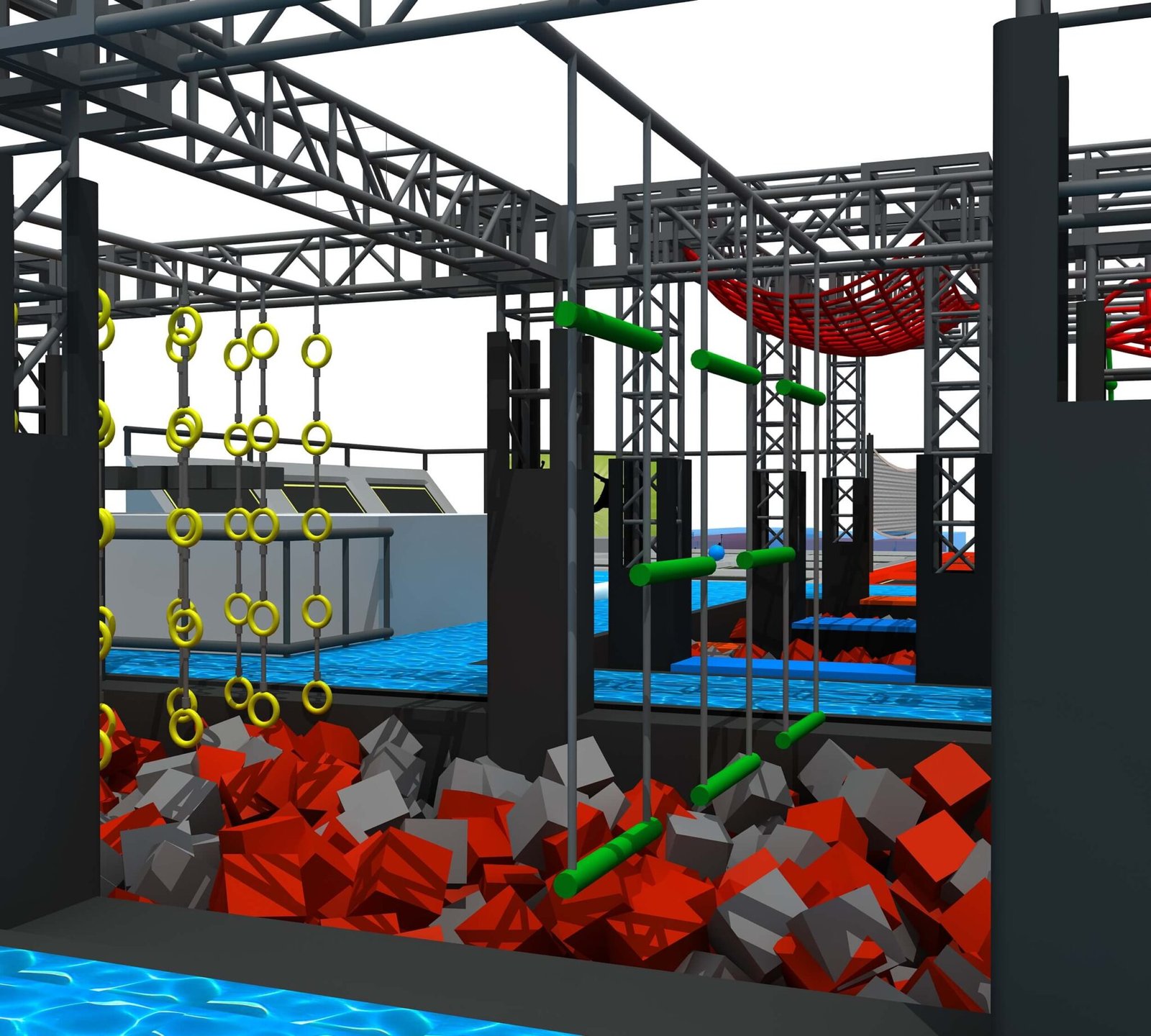
4. US Standards: ASTM F1487, F1918 and F2970 Explained
4.1 ASTM F1487 — outdoor and public play structures
F1487 governs the equipment itself: climbing frames, slides, swings, platforms, typically for ages 2–12. The clauses that decide whether a design passes are guardrail heights by age group and platform height, opening dimensions tested against head-entrapment probes, the extent of the use zone, grip diameters on handholds, and structural loading.
Under the ASTM playground standards, it does not cover soft contained play, which goes to F1918, and it does not cover trampoline courts, which go to F2970.
For Canada, CSA Z614 applies in parallel, and imported projects are frequently asked for an ASTM report by the owner anyway. Supplying an ASTM report with a CSA comparison note normally satisfies both sides in one submission.
We design and manufacture to F1487. Confirm the exact test coverage you need at quotation stage, so that the report scope can be checked against your product range before the order is placed.
4.2 ASTM F1918 — soft contained play
F1918 is the standard behind most indoor soft play structures — the padded, netted, multi-level units that make up a typical indoor playground. It governs soft padding thickness and compression set, the strength of netting and fasteners, entry and exit dimensions, and sightlines from the perimeter into the structure.
It does not apply to open steel or timber structures, and it does not replace F1487 where a project mixes both types. Mixed sites usually need both reports.
Our soft play systems are designed to the F1918 framework. As with F1487, confirm at quotation stage which report scope your project actually requires.
4.3 ASTM F2970-25 — trampoline courts
F2970 covers design, manufacture, installation, operation, maintenance, inspection and major modification of commercial trampoline courts. The current edition is F2970-25; the 2022 edition has been superseded. It applies to courts in trampoline parks, family entertainment centres, theme parks, fitness and gymnastics facilities and similar commercial settings. It excludes consumer trampolines, aquatic trampolines, inflatable devices (which fall under F2374), and stand-alone units below 37,000 in² of bed area that use a harness or mesh-chamber descent control.
The requirements that drive acceptance are mat tension and wear, spring and hook padding, zone separation between activity areas, impact attenuation in landing zones, guardrails on elevated platforms, and the information plate and patron-notice requirements that operators are audited against.
Our trampoline zones are designed and documented in accordance with ASTM F2970-25. Third-party assessment under F2970 can be arranged as a project add-on.
4.4 Which US standard applies to your product
| Project type | Standard |
| Outdoor steel or timber composite play equipment | ASTM F1487 |
| Indoor padded, netted, contained soft play | ASTM F1918 |
| Trampoline court | ASTM F2970-25 |
5. EU Standards: EN 1176, EN 1177 and EN ISO 23659 Explained
5.1 EN 1176 is a set, not a single document
EN 1176 is published in parts. Part 1 sets general safety requirements and test methods; the later parts add product-specific rules — Part 2 swings, Part 3 slides, Part 5 carousels, Part 6 rocking equipment, Part 11 spatial networks. Other parts cover additional equipment categories.
This matters at audit. A report citing only EN 1176-1 is a general-requirements report. It does not demonstrate that the slides and swings on the drawing have been assessed against their own parts. Auditors and notified bodies normally expect the combination of Part 1 plus the part matching each product on site.
5.2 EN 1177 is a surfacing standard, not an equipment standard
EN 1177 determines the critical fall height a surfacing material can absorb, and is assessed together with the equipment because the fall height is derived from the equipment’s platform heights and the age group using it. Equipment assessed in isolation from its surfacing is an incomplete submission, and this is one of the most common gaps in documentation packages.
5.3 EN ISO 23659:2022 — trampoline parks
Sports and recreational facilities — Trampoline parks — Safety requirements, published in November 2022, is the European counterpart to ASTM F2970. It covers design, construction, inspection and maintenance of trampoline parks, including landing areas such as airbags and foam pits, wall trampolines and bungee systems, plus minimum operational requirements.
Its scope wording settles a common confusion: it explicitly excludes children’s playgrounds and directs readers to EN 1176, and it also excludes outdoor trampoline parks and non-trampoline activities. A project procuring soft play does not need this standard. A project adding a trampoline zone generally does.
5.4 Three boundaries in the European system
EN 1176 covers play equipment. EN 1177 covers surfacing. EN ISO 23659:2022 covers trampoline parks. None covers another’s subject matter.
EN 14960 covers inflatable play equipment and sits outside EN 1176. An inflatable supplied with an EN 1176 report is a mismatch.
EN ISO 23659 explicitly excludes children’s playgrounds, which is why a soft play project should not be sold a trampoline-park standard as if it were relevant.
5.5 The European compliance chain
EN 1176 is a harmonised standard. Designing and manufacturing to it creates a presumption of conformity with the applicable essential requirements, which the manufacturer then formalises through a Declaration of Conformity and supporting technical file. The chain runs: standard → presumption of conformity → Declaration of Conformity → technical file retained → checks by customs and by the client.
CE marking is the visible end of that chain, not the start of it. This is why a documentation request should name the declaration and the technical file rather than the mark. Section 11 lists what to ask for.
5.6 After Brexit: UKCA
Great Britain now uses the UKCA marking. CE marking continues to be accepted in Great Britain under the extended recognition arrangements, and CE remains the marking for Northern Ireland. For equipment shipped to the UK, the safest practice is a Declaration of Conformity that states plainly which marking and which standard edition the unit is declared against.
6. ASTM vs EN: Where the Two Systems Actually Differ
The two main sets of playground safety standards do not conflict, and one does not substitute for the other. They differ mainly in legal status and in how they scale requirements by age.
| Point of comparison | ASTM F1487 (US) | EN 1176 (EU) |
| Legal status | Voluntary standard; becomes mandatory when adopted by a state or referenced in a contract | Harmonised standard; conformity creates a presumption of compliance with EU requirements |
| Age grouping | 2–5 and 5–12 years | Grouped by age band and supervision level |
| Use zone | Derived from equipment height and speed | Derived from free-fall height plus horizontal projection |
| Opening dimensions | Head-entrapment probe testing | Similar testing, different critical values |
| Guardrail height | Banded by age group | Banded by platform height and age group |
| Evidence of conformity | Third-party test report | Self-declaration plus technical file; third-party testing optional |
| Practical implication | Required for North American projects | Required for European projects |
Three conclusions follow.
They are not interchangeable. A unit tested to one system has not been tested to the other, and the test methods differ in ways that matter at the margins — probe dimensions, use-zone geometry, guardrail bands.
Dual compliance is achievable, but it is a design decision, not a paperwork decision. Where a design must satisfy both, the platform heights and guardrail bands need to be fixed at the layout stage, before drawings are frozen. Retrofitting dual compliance after manufacture is usually not economic.
For markets that mandate neither system, the choice is a commercial one: deliver against whichever system the owner, the insurer or the tender document names, and state clearly on the Declaration of Conformity which edition was applied.
7. South America and Other Markets: What Buyers Actually Require
Europe, the Americas and South America are where most of our projects close, and the way playground equipment safety standards are applied differs enough between them to be worth setting out separately.
7.1 The reality on the ground
Brazil, Chile, Colombia, Peru and Argentina generally do not operate a dedicated mandatory standard system for play equipment. In practice, an EN or ASTM report is what an owner’s inspector, a shopping centre’s technical department or an insurer will ask to see. Some countries publish local rules — Brazil’s ABNT NBR 16071 is the best-known example — but coverage and enforcement vary.
Customs clearance in the region usually focuses on product safety certification, invoice and certificate of origin, and material declarations, rather than on a play-equipment-specific standard.
7.2 The three documents South American buyers ask for most
| What they ask for | What it is used for | What it should state |
| EN or ASTM test report | Owner acceptance, fire approval, insurance | The standard, the edition, and a report number that can be verified |
| Material and flame-retardant declaration | Shopping centre or fire department submission | Which material was tested to which fire standard |
| Declaration of Conformity | Import clearance, owner’s file | Which standard and edition the product is declared against |
7.3 For distributors: why these three documents drive your cash flow
Without a report, you cannot bid. Tender documents from shopping centres and chain FEC operators commonly list compliance with EN or ASTM as a qualification item. Missing it does not reduce your score; it removes you from the evaluation. Price never enters the conversation.
Without a report, the final payment slips. South American projects are commonly structured in instalments, with the balance tied to acceptance — and acceptance is decided on these documents. The document is typically requested at the point where money moves, which in this region is earlier in the deal than most suppliers expect.
Without a report, the liability is yours. The distributor is the local legal entity. After an incident, the ability to produce equipment conformity documentation is what separates a defensible position from an exposed one.
In this region, certification documents are not a value-add. They are the instrument that gets you paid.
7.4 For owners: how the same documents convert into opening dates and premiums
Inside a shopping centre, fire approval and property management review are decided on flame-retardant and structural documentation. Each missing item is a separate site visit and a separate delay, and rent runs throughout.
For a standalone venue, equipment conformity documents are a required attachment to the operating licence application.
For insurance, property and public liability underwriters ask whether the equipment conforms to a recognised standard. Incomplete documentation is a common reason for an exclusion, a loading, or a declined quote.
Documentation that is complete at the start removes rework, removes repeated correspondence, and moves the opening date forward. The saving is measured in weeks of rent, not in the cost of the documents.
7.5 The Middle East and Southeast Asia
Owners in these regions usually specify ASTM or EN. Where local regulation is silent, ASTM is often the simpler route because it is what international operators and insurers already recognise.
Saudi Arabia and the UAE may require SASO or ESMA conformity certificates for certain projects. These are product market-access certificates, not play-equipment standards, and they are additional to the ASTM or EN report rather than a substitute for it.
7.6 The short version
Outside Europe, North America, Australia and Canada, most markets do not require a separate play-equipment standard — they accept an ASTM or EN report. Building both is therefore the closest thing to global coverage available. And in South America specifically, the function of that report is not compliance. It is getting paid.
8. Surfacing and Impact Attenuation: ASTM F1292 and EN 1177
A safe structure over hard flooring still injures children, and this is where a well-built unit fails acceptance. ASTM F1292 in the United States and EN 1177 in Europe govern how a surfacing material performs when a child falls onto it, measured through deceleration over a defined drop height.
The point that matters for procurement is that the two are assessed as a pair. A surfacing that does not match the equipment’s fall height will fail the acceptance review even if the equipment report is complete. When you receive a documentation package, check that the surfacing report names the same critical fall height the equipment report derives.
This section is deliberately short: surfacing calculations warrant their own treatment. The full method for deriving critical fall height, the material comparison and the failure points that show up in acceptance reviews are set out in our guide to ASTM F1292 and critical fall height — linked here rather than repeated, so that each page answers one question properly.
9. Fire Standards for Playground Materials
Indoor playgrounds are built from foam, fabric, netting and carpet — materials that burn. Fire review is therefore a standing item on every indoor project, and it is assessed at material level, not at unit level.
Four standards appear most often: NFPA 701 for textiles and films, UL 94 for plastics, EN 13501-1 for the European reaction-to-fire classification, and ASTM E1354 for cone calorimeter data used to support the classification.
The distinction buyers most often miss: a material passing a fire test is not the same as a finished unit being certified. A supplier can legitimately state that its fabrics are tested to NFPA 701 while holding no fire assessment of the assembled structure. Both statements can be true, and only the first is usually claimed.
The consequence of getting this wrong is not a rejected shipment. It is arriving at a site that cannot open, with rent accruing and staff hired. Our guide to playground fire standards covers the material comparison and selection logic in detail.
10. CE Marking: What It Actually Means
CE marking is not a certificate issued by an EU authority. It is a declaration by the manufacturer that the product conforms to the applicable EU requirements, supported by a technical file the manufacturer retains and produces on request.
10.1 What the manufacturer actually does
The manufacturer carries out a risk assessment, identifies the applicable directives and harmonised standards, assembles a technical file, issues a Declaration of Conformity, and affixes the marking. For most play equipment, there is no notified body certificate at the end of this process.
10.2 When a notified body is involved
Whether third-party involvement is required depends on the product category and the directives that apply. For standard play equipment it is usually optional; for certain categories it is not. A supplier who states “notified body certified” for a product category that does not require it is worth questioning.
10.3 Why “CE certification” is so widely said
Partly colloquial habit, partly borrowed authority — and in the field of indoor playground safety standards, the phrase is used most often by suppliers who have the least to show.
10.4 The question that gets a real answer
Instead of asking “Do you have CE certification?”, ask: “Can you send the Declaration of Conformity and the technical file index, and state which standard edition the declaration references?” A supplier holding a genuine technical file answers in one email. A supplier who has been using the phrase loosely tends to answer with a picture of a logo.
A supplier who can answer that question precisely, and name the edition, is the one whose documentation will survive a customs or insurance review.
11. Documents You Should Request from Any Supplier
A quotation without documents is a price, not an offer. These eight items are what a complete package contains.
| # | Document | What it proves |
| 1 | Declaration of Conformity (DoC) | Which standard and edition the product is declared against |
| 2 | Third-party test report, with report number | That testing actually took place, and by whom |
| 3 | Accreditation statement for the testing body | That the laboratory was qualified to run the test |
| 4 | Material schedule and material certificates | Steel grade, foam density, netting specification, fabric composition |
| 5 | Fire test reports | Material performance for fire review |
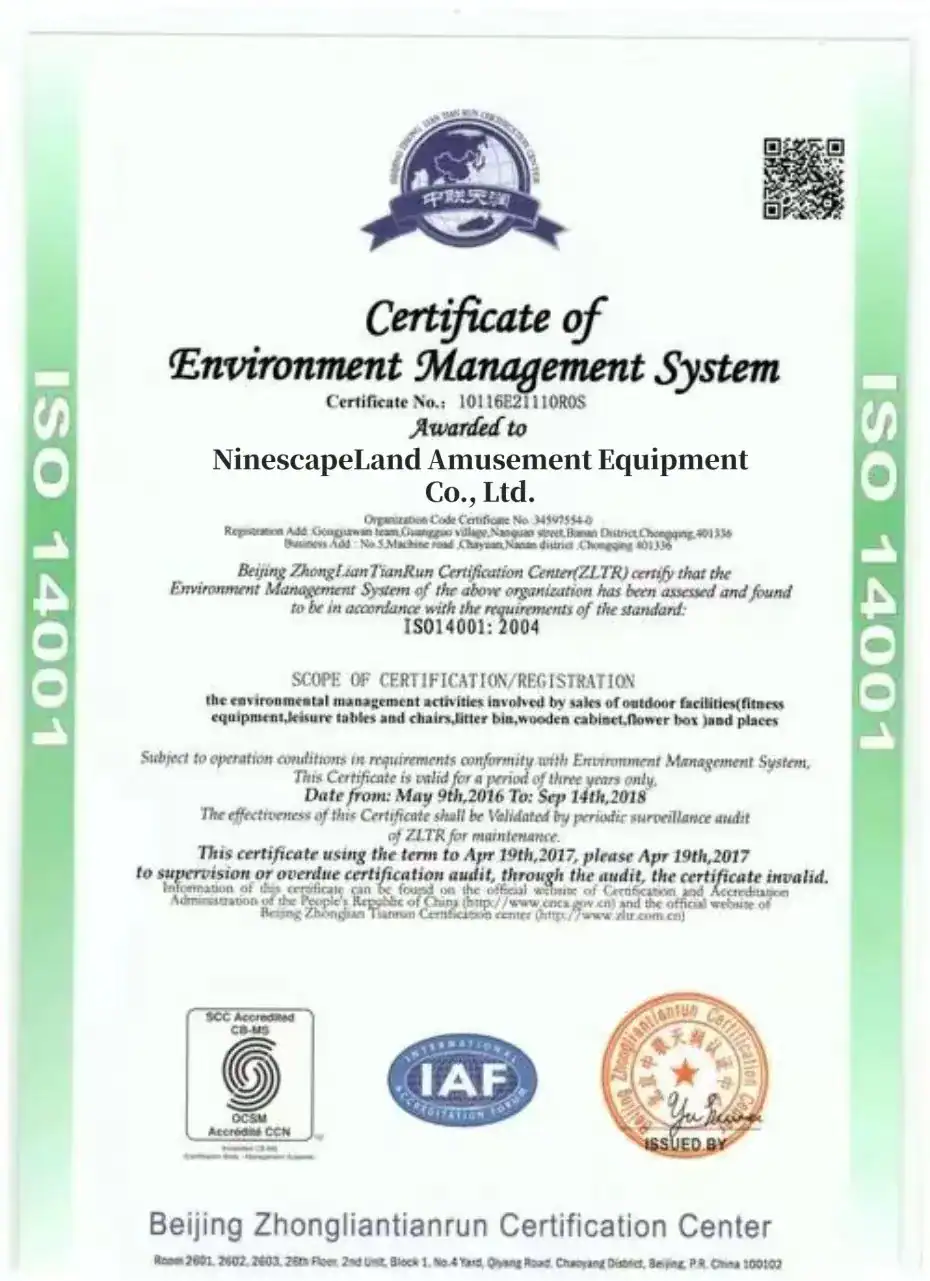
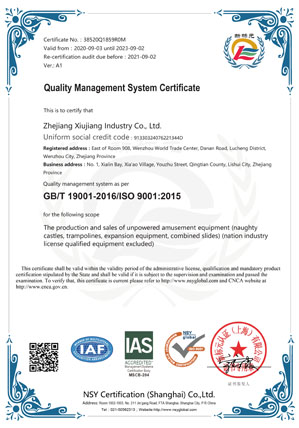
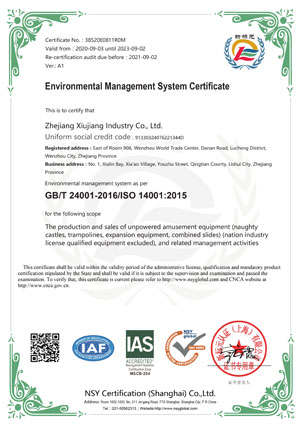
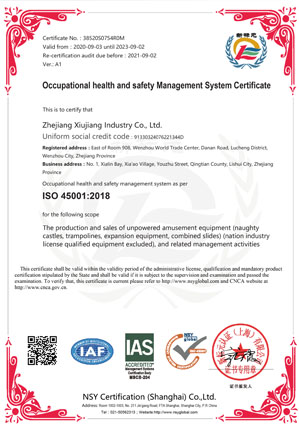
| 6 | Factory system certificates (ISO 9001, 14001, 45001) | That the production process is under documented control |
| 7 | Factory audit report | That the supplier is a manufacturer, not a trading company |
| 8 | Installation and maintenance manual | The document insurers and annual inspectors ask for |
Receiving these eight items is the starting point. The more useful question is what each one does for you in your own market — which is the subject of the next section.
12. What These Standards Actually Do for You
The safety standards for playground equipment on their own earn nobody anything. The ability to prove conformity is what earns — which is why a procurement conversation should start with documents and only then move to price.
The same eight documents behave very differently in the hands of a distributor and in the hands of an operator. Both readings are worth understanding, because most projects involve both parties.
12.1 For distributors and integrators: four things that decide whether the deal happens
| # | Situation | With documentation | Without it |
| 1 | Tender qualification | Compliance with ASTM F1487 or EN 1176 is commonly a pass/fail qualification item; the report is the entry ticket | Your quotation never reaches evaluation. This is not a pricing problem, it is an eligibility problem |
| 2 | Liability separation | The report is written evidence that reasonable diligence was performed | As the local legal entity, you carry the evidential burden after an incident |
| 3 | Sales velocity | One document pack forwards to the client; your sales team stops asking the factory | Every enquiry stalls on “let me check the test report”, and deals age out |
| 4 | Market access and insurance | Some markets require conformity documents for an operating licence or a policy | The client cannot open, the equipment sits idle, and the balance payment is disputed |
For a distributor, certification documents are not technical literature. They are tender eligibility, liability cover and collection speed.
12.2 For owners and operators: four things that decide when you open
| # | Situation | With documentation | Without it |
| 1 | Opening approval | Fire, building and property management review start with these documents | The site stalls at inspection while rent continues |
| 2 | Insurance terms | Underwriters assess whether equipment conforms to a recognised standard | Declined cover, a premium loading, or an exclusion for equipment defects |
| 3 | Post-incident position | Conformity documents build the evidential chain that the equipment was specified to industry standard | An unfavourable liability finding, with uncontrolled settlement exposure |
| 4 | Expansion and modification | The existing report either covers new units or shows what needs re-assessment | Adding equipment without checking triggers a full re-submission and a second delay |
For an owner, certification documents are not a compliance cost. They are the opening schedule and the insurance policy.
12.3 The same document, read two ways
| Document | What a distributor does with it | What an owner does with it |
| ASTM / EN test report with number | Attaches it to a bid; clears a client’s first screening | Submits it for fire approval and insurance underwriting |
| Declaration of Conformity | Customs clearance, marketplace listing | Owner’s file, inspection response |
| Fire test reports (NFPA 701 / EN 13501-1) | Mandatory for indoor project tenders | Fire acceptance on site |
| ISO system certificates (9001 / 14001 / 45001) | Demonstrates manufacturer status rather than trading status | Assesses long-term supplier stability |
| Installation and maintenance manual | Part of the handover pack; reduces after-sales disputes | Annual inspection, policy renewal, staff training |
12.4 What we have seen, and what it costs
In projects we have reviewed, the three most common document problems are: a test report covering only EN 1176-1 without the product-specific part; a report whose model number does not match the quotation; and a certificate that covers a material rather than the finished unit.
In our experience, the hardest problems to fix are not technical ones. They are paperwork mismatches discovered at the bid deadline or at customs — moments when there is no time left to correct them.
What we have seen repeatedly is this: buyers request test reports at the last stage of a deal, after price, layout and lead time are settled. That is precisely when a missing document costs the most.
If you have ever had a quotation rejected without explanation, or a client go quiet immediately after asking for test reports, this is usually why.
None of it requires technical capability to avoid. It requires one document check before the price is agreed.
13. Work With Us: Two Ways to Start
NINESCAPELAND has manufactured commercial indoor play equipment since 2008, with more than 1,000 projects delivered across 75+ countries. Europe, the Americas and South America are where we close most often, which is why the documentation practice in this guide is written around those three regions. Our factory in Wenzhou covers 50,000 m² and employs more than 200 people; we are a manufacturer, not a trading company.
We have seen too many projects blocked at customs, at fire review or at insurance — long after the safety standards for playground equipment had been agreed on paper. That is why this reference is public.
There are two ways to start, depending on which side of the project you sit on.
Start with the document pack, not with an order.
-
Documentation pack. The eight document types listed in Section 11, assembled for your bid: third-party test reports with report numbers, CE Declaration of Conformity, GB/T 19001 (equivalent to ISO 9001), GB/T 24001 (equivalent to ISO 14001), ISO 45001, and material fire test reports.
-
Compliance mapping. Tell us the destination country and the product type, and we return a table showing which standard applies and which documents are required.
-
OEM / ODM. Configurations adapted to your brand and to local clause requirements.
-
Catalogue and localisation material for your sales team.
Commercial terms — territory protection, first-order support, MOQ and payment terms — are agreed per market.
Request the Distributor Document PackNo order required. Take the pack and put it into a live bid first.
Start with the site, not with a catalogue.
-
Free 3D design. We work from your ceiling height, floor area and circulation route, and mark guardrail heights, use zones and opening dimensions into the layout at design stage — before the drawings are fixed.
-
Compliance checklist. A list of the documents and tests required for your destination market.
-
Modification assessment. Whether your existing equipment and reports cover the units you are adding, and what would need re-assessment.
You do not need drawings to start. Site length, width and height are enough.
14. FAQ
Are safety standards for playground equipment legally required? Not directly — they are published standards, not statutes. In practice they become mandatory when a state or national regulation adopts them, when a tender document names them as a qualification item, or when an insurer makes cover conditional on them. On commercial projects, one of those three usually applies.
What is the difference between ASTM F1487 and EN 1176? F1487 is the US structural standard for outdoor and public play equipment; EN 1176 is the European set, published in parts, covering the same equipment categories with different test methods and different critical values. A report against one is not accepted as evidence for the other.
Do indoor playgrounds need ASTM F1918? For soft-contained play in North America, F1918 is the standard owners and insurers expect. In Europe, the equivalent assessment is made under EN 1176. Mixed sites containing both soft play and open structures normally need both assessments.
Is CE marking mandatory for playground equipment? CE marking is required for products within the scope of an applicable EU directive, and play equipment generally falls within such scope. What is mandatory is the conformity assessment, technical file and Declaration of Conformity — not a certificate from an EU authority.
Which standard do South American buyers usually accept? EN or ASTM. Most countries in the region have no dedicated mandatory play-equipment standard, so the owner's inspector, the shopping centre and the insurer accept a report against one of the two. Supplying both removes the question entirely.
Can equipment be certified to both ASTM and EN? Yes, and it is a design decision rather than a documentation exercise. Platform heights, guardrail bands and use-zone geometry must satisfy both systems at layout stage. Retrofitting dual compliance after manufacture is rarely economic.
The safety standards for playground equipment covered here are revised on a multi-year cycle. Editions cited reflect the position at the time of writing; always confirm the current edition before a submission, and follow the tender document or local regulation where it is stricter.
Not sure which system applies to your project? Send us the destination country and site dimensions, and we will return a compliance mapping table.