
Quick Answer
Trampoline park vs indoor playground — which is better? Neither wins by default. Three measurable conditions decide it: floor area, clear ceiling height, and the age profile of your catchment.
Based on the projects NinescapeLand has delivered, an indoor playground stays viable below roughly 300㎡. A trampoline park generally needs 800㎡ or more before throughput economics work. Between those two points, a hybrid usually earns more than either format alone. These are practical ranges, not industry standards — your ceiling height and catchment decide the rest.
At a Glance: Indoor Playground vs Trampoline Park Compared
| Factor | Indoor Playground | Trampoline Park |
|---|---|---|
| Primary age range | 6 months – 12 years | 5 – 45 years |
| Core experience | Climbing, sliding, role-play, sensory play | Bouncing, aerial tricks, dodgeball, ninja challenges |
| Typical floor area | 15㎡ – 1,300㎡ (works in irregular units) | 300㎡ – 2,000㎡+ (needs open span) |
| Clear ceiling height | 3.5 – 5m is usually enough | 5 – 8m+ required |
| Equipment cost drivers | Structure volume, slides, theming, soft-play density | Jump-bed area, spring and frame spec, padding |
| Retail ticket price (market reference) | $12 – $20 per visit | $18 – $32 per hour |
| Revenue structure | Admission, memberships, parties, café | Timed sessions, group events, parties, fitness |
| Supervision & insurance | Lower risk; general attendants | Higher risk; trained monitors, waivers, higher premiums |
| Best-fit venue | Mall units, community FEC, hotels, kindergartens | Warehouses, standalone FEC, regional destinations |
Ticket prices above are retail market ranges for reference only.
The Three Conditions That Actually Decide It
Condition 1 — Floor area
Start with the lease, not with preference.
- Under 300㎡ (≈3,200 sq ft): an indoor playground is usually the practical choice. A trampoline park this small leaves too little jump-bed area to sell timed sessions at a workable price, and buffer zones consume the rest of the floor.
- 300 – 800㎡ (≈3,200 – 8,600 sq ft): both formats can work. The decision shifts to who lives within a 15-minute drive — families with under-8s, or teenagers and group bookings.
- 800㎡ and above (≈8,600 sq ft+): a trampoline park usually out-earns a playground per square metre when the jump zone dominates the floor. Throughput per hour scales with jump area, so the more of the floor the jump area takes, the stronger that case. This is also where a hybrid has room to work.
Condition 2 — Ceiling height (indoor playground ceiling height requirements)
Signing a lease that cannot support your planned format is the most expensive mistake in this industry.
- Indoor playground: 3.5 – 5m clear height is usually enough. Multi-level structures stack activity vertically, so a two- or three-tier unit delivers a lot of play value in a modest footprint.
- Trampoline park: 5 – 8m clear height is the practical floor. Below that you lose wall features, supervision sightlines, and safe jump trajectories. If a landlord says the ceiling can be raised, get it in writing before you sign.
Survey the space before layout: structural columns, sprinkler lines, HVAC runs, lighting and exits. One column in the wrong place removes two trampoline beds — or forces a full playground redesign.
Condition 3 — Who is actually in your trade area
- Family-dominant catchment: indoor playground. Parents stay on site, buy coffee, book parties. Dwell time is long and repeat visits are frequent.
- Youth- and group-dominant catchment: trampoline park. Timed sessions, school outings and team events produce higher revenue per head.
- Mixed catchment: a hybrid usually captures both.
What Actually Drives the Cost
Search for “indoor playground cost per square metre” and you will find dozens of pages quoting one number. Treat them with suspicion. That number usually ignores shipping, installation, floor preparation, fire compliance and customisation. It is not a price. It is a marketing figure that makes every real quote look wrong later.
Equipment cost depends on five things:
1. Floor area and ceiling height. Area sets the size of the structure. Ceiling height decides whether that area can be used vertically. A 300㎡ unit with 7m clearance hosts far more play value than one with 3.2m.
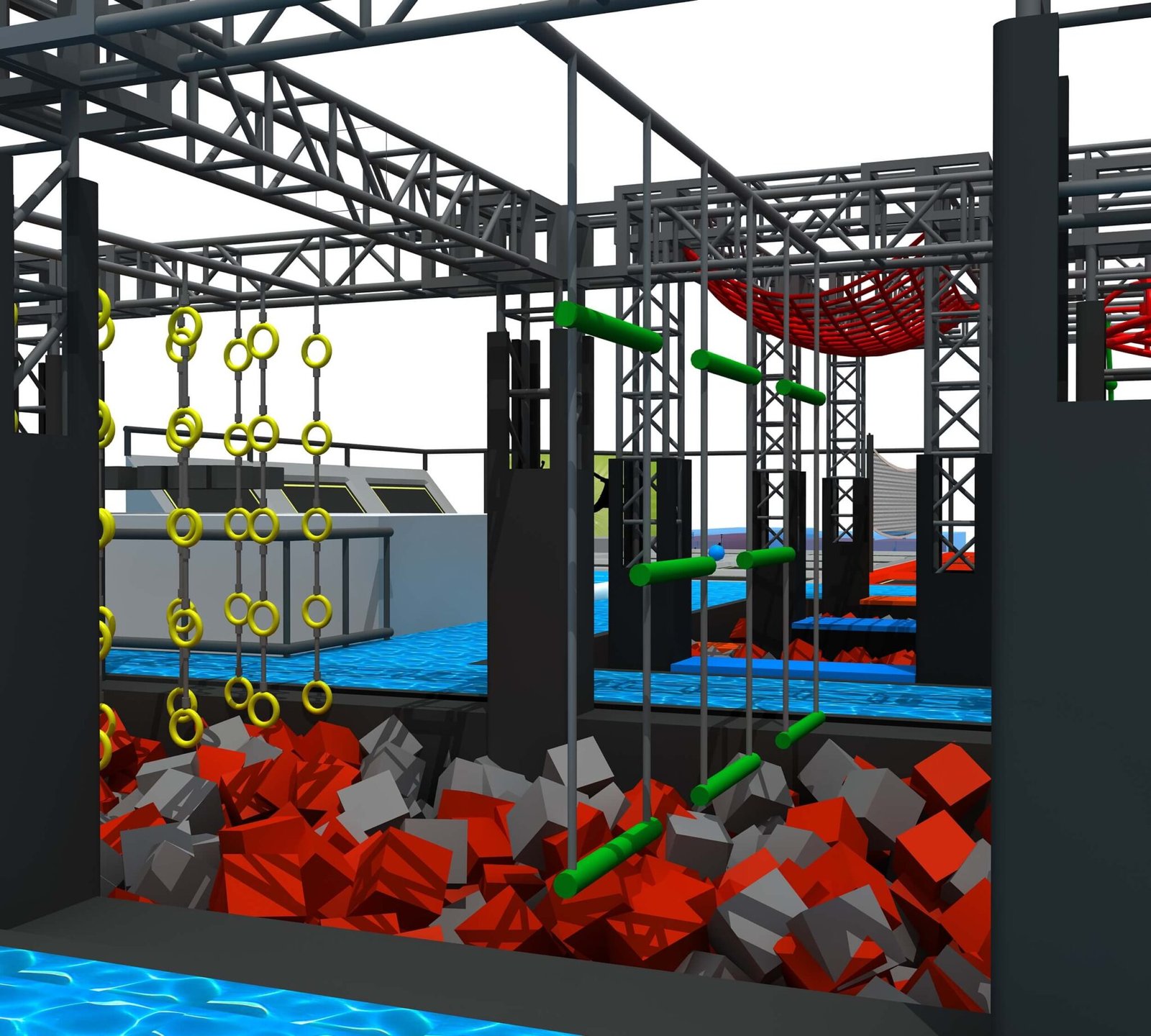
2. Attraction mix. Soft play, trampoline beds, ninja courses, climbing walls and interactive projection have very different cost curves. Two projects of the same size can differ twofold on equipment budget, simply because one includes a climbing wall.
3. Customisation and theming. Standard modular components are cheapest per unit. Bespoke theming — a branded slide tower, a themed façade, printed padding — is labour-intensive and priced accordingly.
4. Shipping, installation and site preparation. Container planning, destination port, on-site labour, lifting, floor flatness and electrical work sit outside the equipment line. For a landlocked market, freight alone can move the total significantly.
5. Compliance and certification. Testing to ASTM F1918 / F1487 (North America), EN 1176 / 1177 (Europe), CE marking and fire performance to EN 13501-1 or NFPA 701 all cost money. Requirements differ by country and by insurer.
Equipment-only vs turnkey
This is where most first-time buyers get confused.
| Scope | What it covers | Typical question |
| Equipment-only | Manufactured structures, shipped to your port | “How much is the equipment?” |
| Turnkey | Equipment + design + shipping + installation + coordination | “How much to open the doors?” |
Both are legitimate. They are not comparable. Any supplier who mixes them in one sentence is either careless or deliberately confusing you.
NinescapeLand’s approach: quote from the floor plan, not from a price list. Send the area, clear ceiling height, target market and opening date, and you receive a line-item proposal you can compare against another supplier’s.
When an Indoor Playground Is the Better Choice
If you are still weighing an indoor playground or trampoline park, this is the test to run. Choose an indoor playground when the numbers point that way — not because it looks gentler.
Choose it if:
- Leasable area is under about 300㎡, or the unit is irregular with limited depth
- Clear ceiling height is 3.5 – 5m and cannot be raised economically
- The catchment is family-dominant, with many households with children under 8
- You want high visit frequency rather than high spend per visit
- Birthday parties are likely to become a major revenue line
- You are a first-time operator and want leaner staffing and lower insurance exposure
What it will not do: turn teenagers into repeat customers. The economics depend on parents.

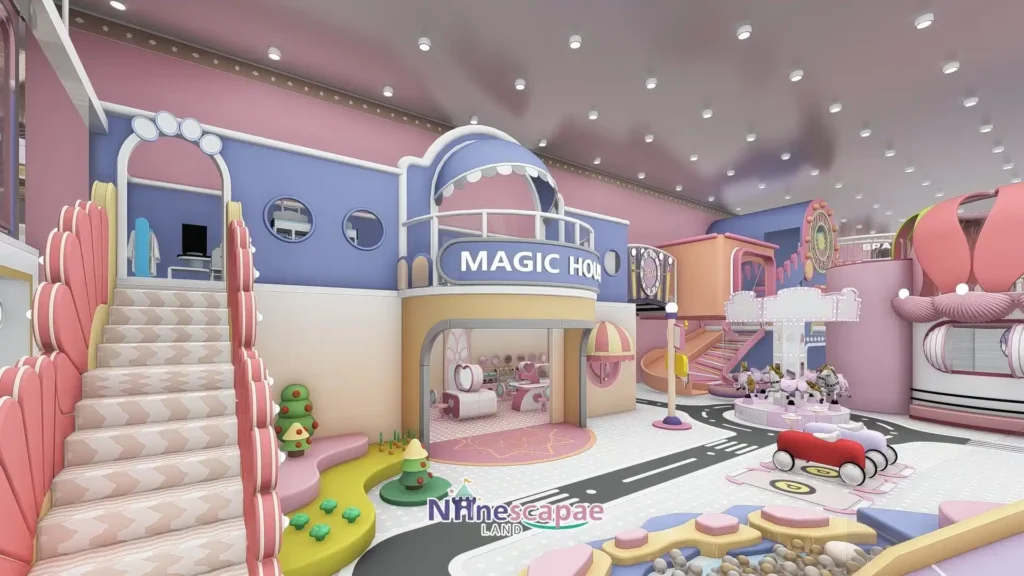
Reference projects: 74㎡ Malta and 1,300㎡ Canada
Two NinescapeLand delivered projects bracket the format’s real range.
A 74㎡ (≈800 sq ft) installation in Malta sits near the small end for a complete, standalone venue. At this footprint a trampoline park would leave too little jump area to sell sessions at a workable price. A multi-level soft-play structure with a compact toddler zone fits comfortably — inside a retail unit that would otherwise sit empty.
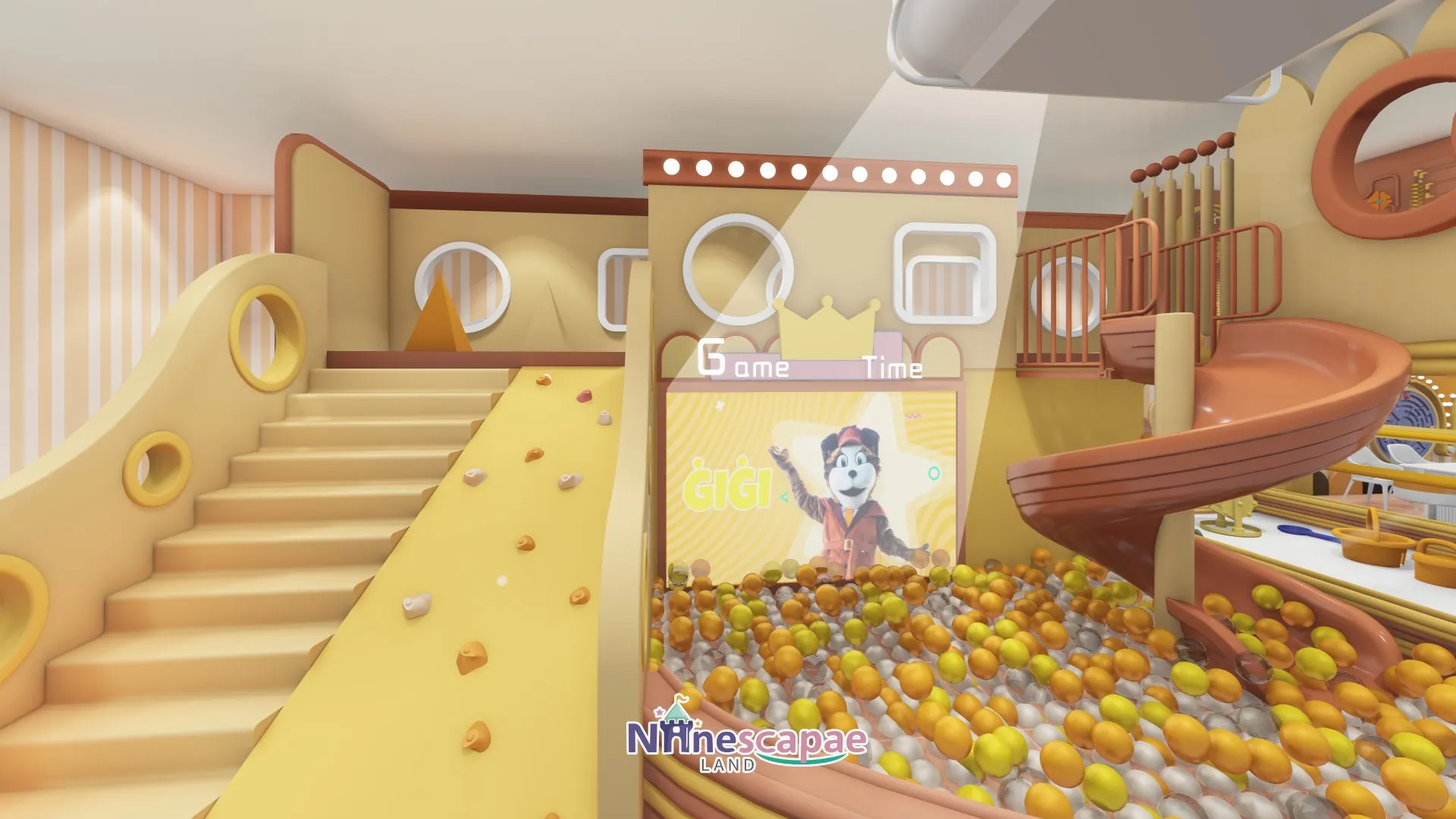
At the other end, a 1,300㎡ (≈14,000 sq ft) family entertainment centre in Canada shows how far the format can scale when the catchment supports it. Note what it is: a genuinely mixed venue — a full multi-level soft-play structure with slides for younger children, a separate trampoline zone, and party rooms and F&B alongside.
That is the point worth underlining: square metres set the ceiling, not the format. NinescapeLand has delivered large venues as near-pure soft play, and large venues as hybrids. What changes is how the floor is zoned — and that follows the catchment, not the lease size.
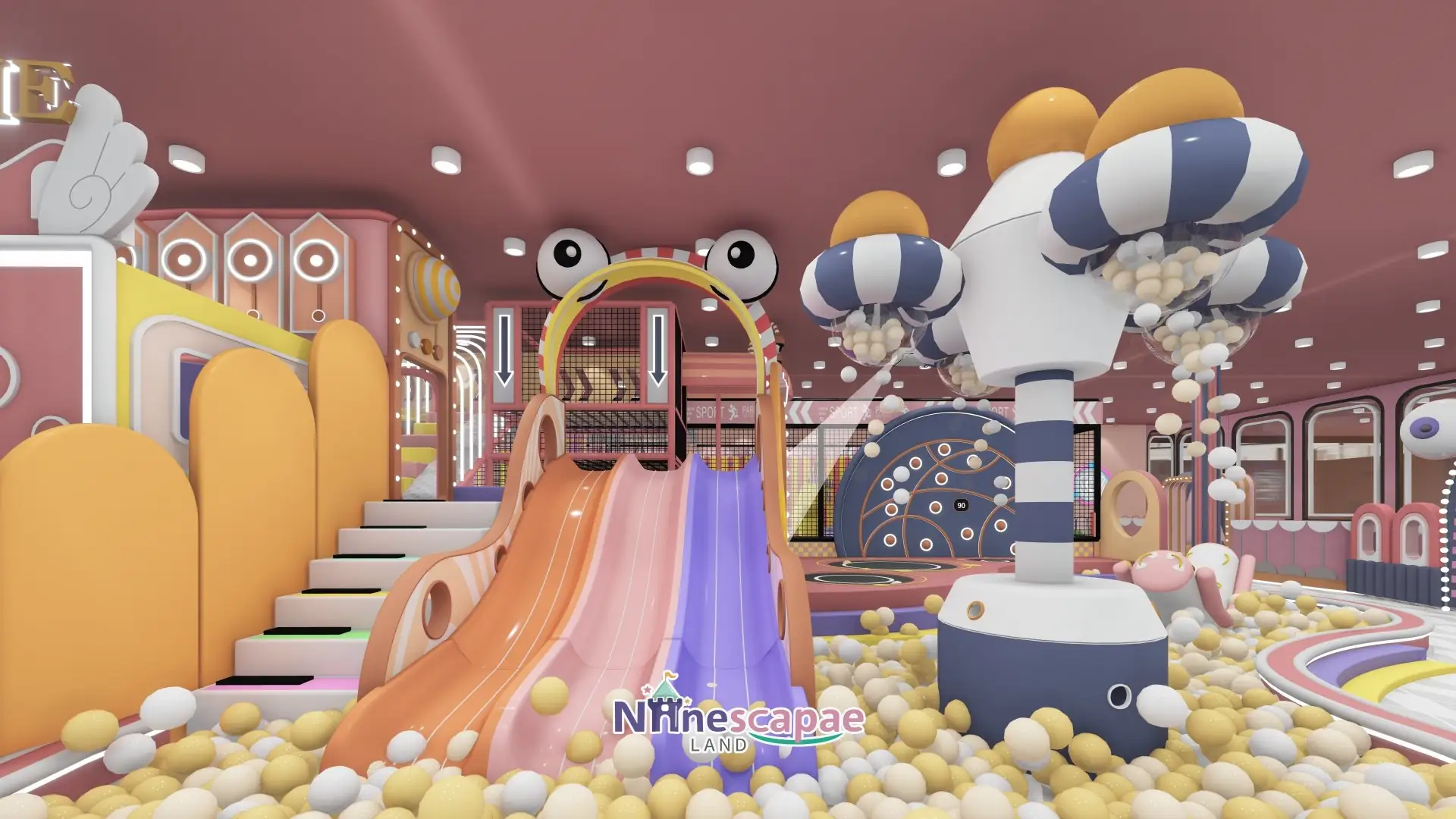
Both were manufactured at the NinescapeLand factory in Wenzhou, Zhejiang. Installation scope varies — from on-site supervision and technical support through to a fully installed handover, depending on the contract.
Choosing the right indoor playground manufacturer: a soft-play structure is largely static. What matters over ten years is padding quality, netting strength, spare-part availability and whether the design can be serviced. Those are engineering decisions made at the factory, not on site.
When a Trampoline Park Is the Better Choice
Choose a trampoline park when the building supports it and the market rewards throughput. For most of the venues NinescapeLand quotes, the split between an indoor playground or trampoline park comes down to the two numbers above.
Choose it if:
- You have 800㎡ or more of continuous open span, with few columns
- Clear ceiling height is 5m+, ideally 6 – 8m
- The catchment skews to teenagers, young adults and group bookings
- You can run timed sessions and enforce rules consistently
- You are ready to budget for trained monitors, waivers and higher premiums
- You want higher revenue per visitor and accept weekend-concentrated demand
What it will not do: rescue a poorly zoned floor plan. In a trampoline park, layout is the product. A bad plan caps throughput permanently. Marketing cannot fix it.
This is where your trampoline park manufacturer matters most. A park is a high-force, high-wear environment. Ask any trampoline park manufacturer for the bed tension and frame spec in writing, and compare the numbers rather than the brochure. Bed tension, spring spec, frame rigidity, padding thickness and the way zones are separated all decide how often you stop operating to repair. A cheap frame costs more over five years than a correct one.
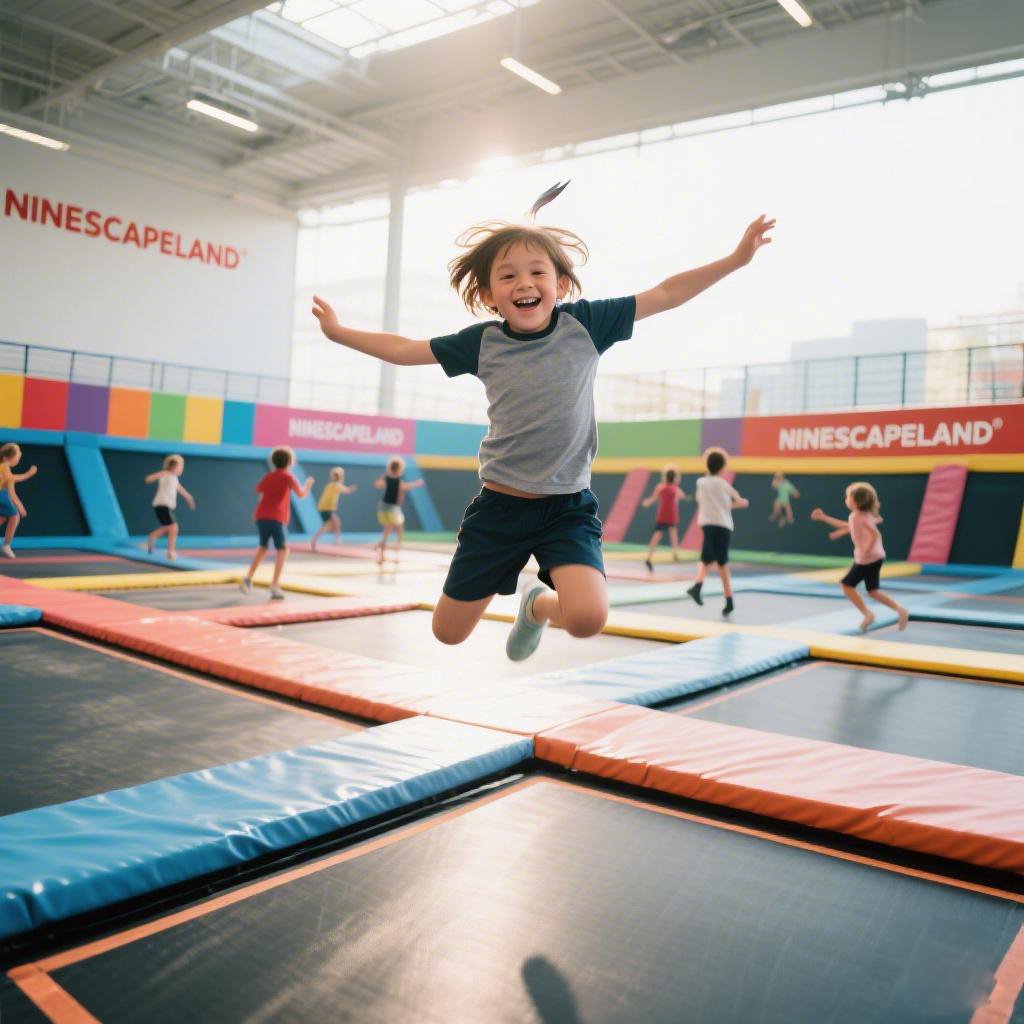
Reference project: trampoline park, Brazil
A trampoline park delivered by NinescapeLand in Brazil — one of several jump parks in the portfolio, from South America to Southeast Asia. The photos show the working core: interconnected open-jump beds, angled wall features, padded landing zones and foam pit access, all specified around the available clear height.
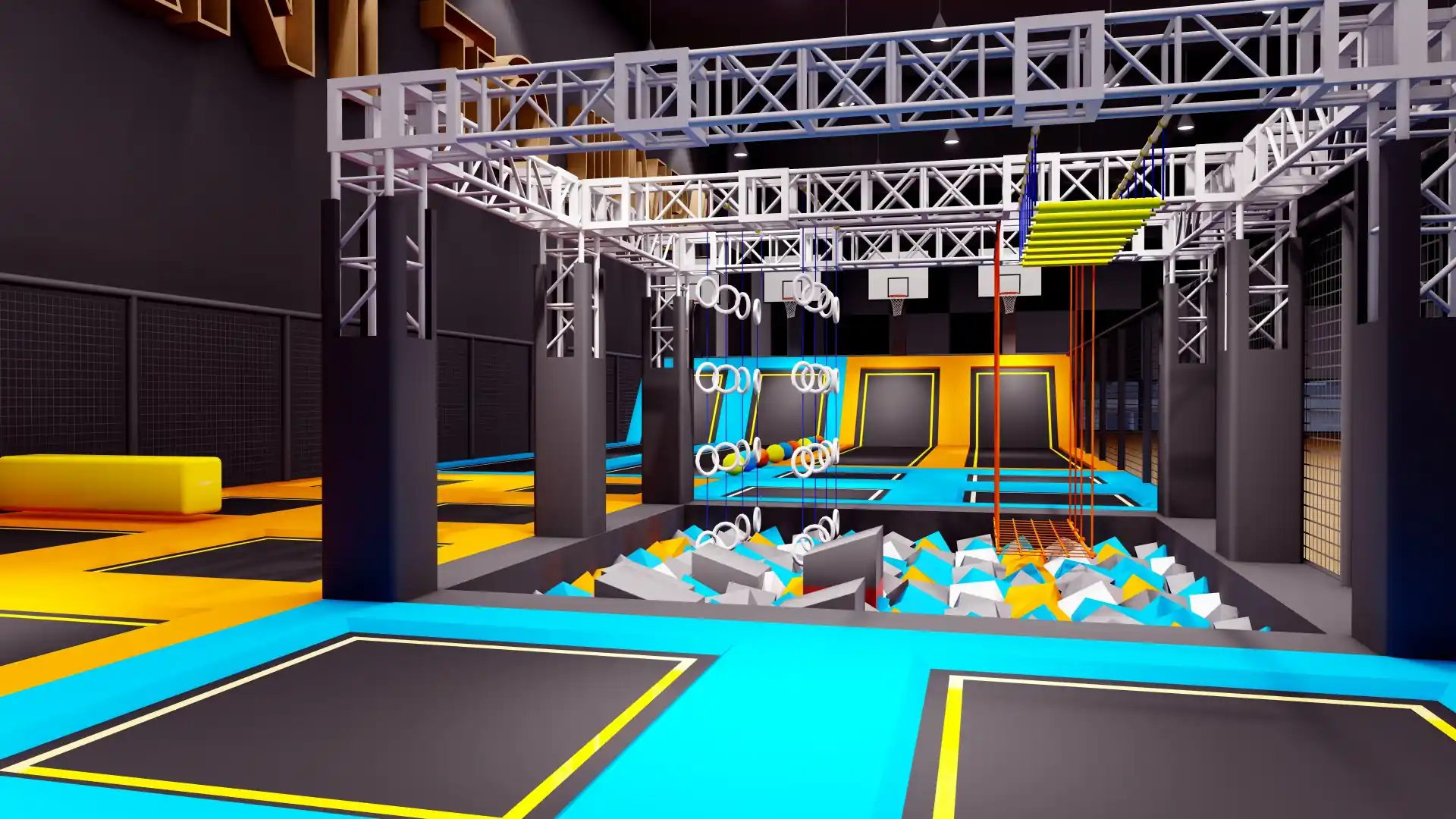
The Hybrid Model: Why Most 300 – 1,300㎡ Venues Should Combine Both
Most comparison articles skip this section. It is where the money is.
A hybrid works on simple arithmetic. An indoor playground monetises young families on weekday afternoons. A trampoline park monetises teens and groups on weekends. Run one, and half your floor sits idle half the week. Run both with proper zoning, and you fill the calendar.
A hybrid family entertainment center is not two businesses in one shed. It is three zones with distinct rules.
| Venue size | Configuration | Why it works |
| 150 – 300㎡ | Soft play core + compact jump zone + small café | Keeps the under-8 audience while giving 9–13 year-olds a reason to come back |
| 300 – 800㎡ | Toddler soft play + open jump arena + ninja elements + 2 party rooms | The workhorse layout. Three age bands served at once |
| 800 – 1,300㎡ | Trampoline courts + ninja course + climbing wall + full soft play + party rooms + F&B | Destination format. Draws from a wider trade area |
Two things that decide the equipment specification
Zoning is not a soft-play question, it is an equipment question. Two decisions fix the specification before a single drawing is made.
Age separation fixes the equipment split. A toddler soft-play zone and an open jump arena need two different impact surfaces and two sets of clearance rules. They also need a physical barrier between them. Decide the split early — retrofitting a barrier into a finished layout usually means rebuilding the adjacent structure.
Reserve the expansion capacity at design stage. Structural tie-in points and MEP loads for a future ninja course are cheap to design in. They are expensive to add later. NinescapeLand specifies these provisions at phase one, even when phase two is years away.
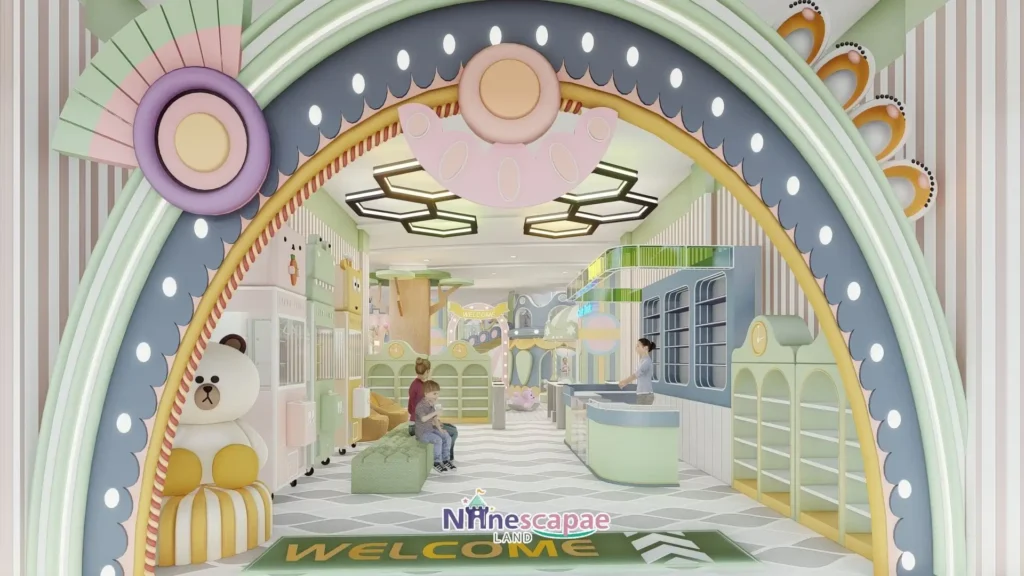
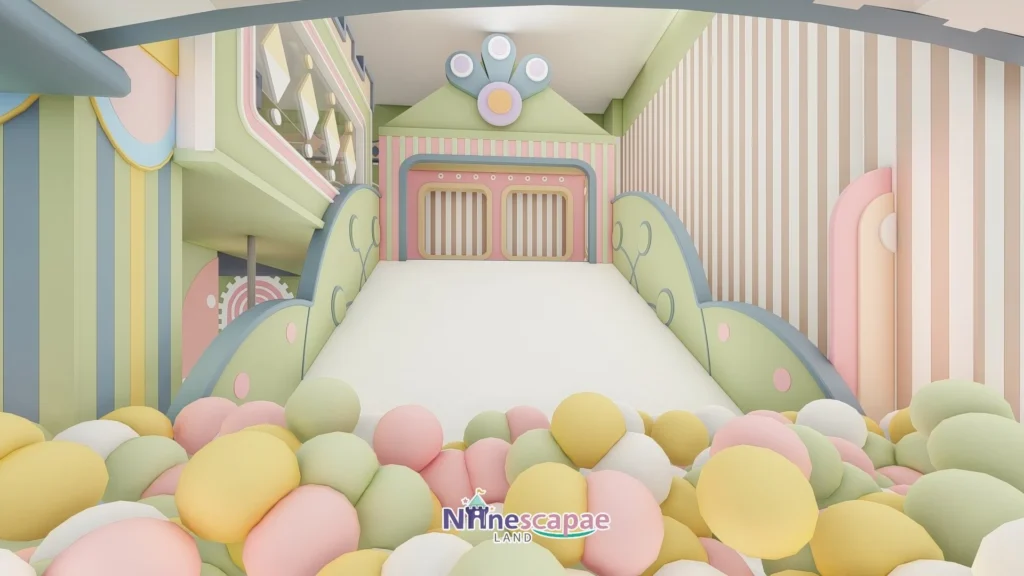
Delivered projects at each scale
245㎡, United States
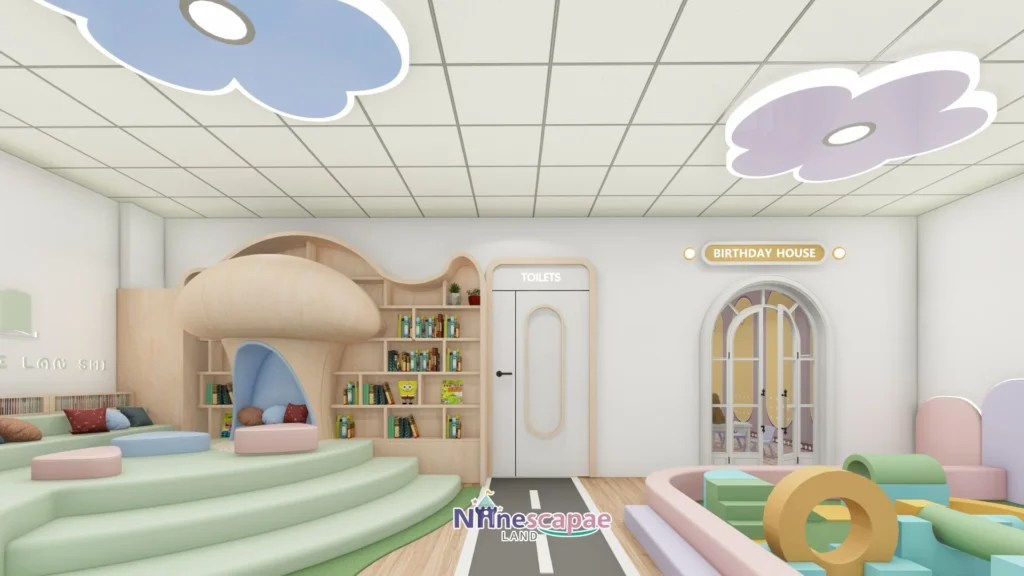
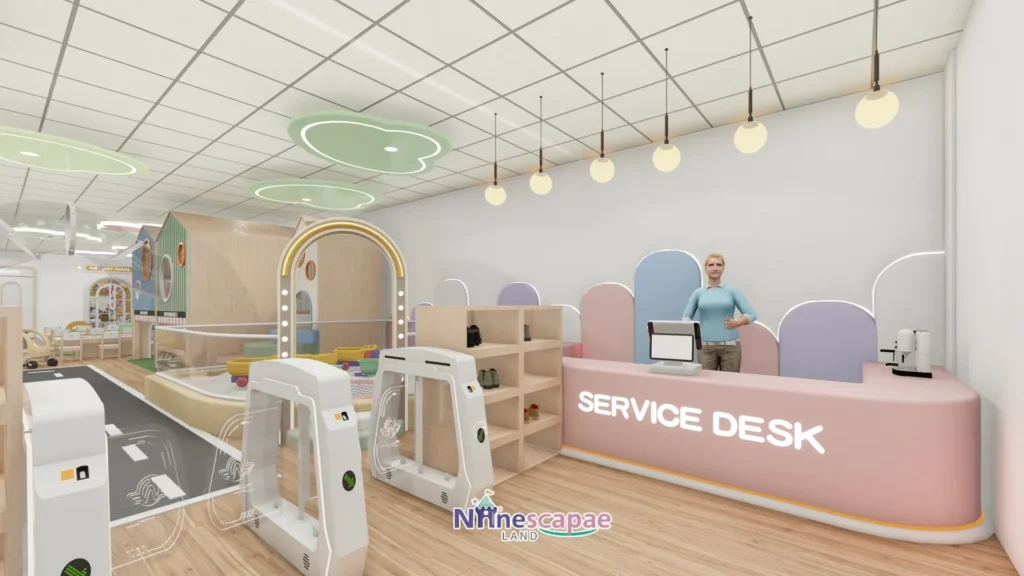
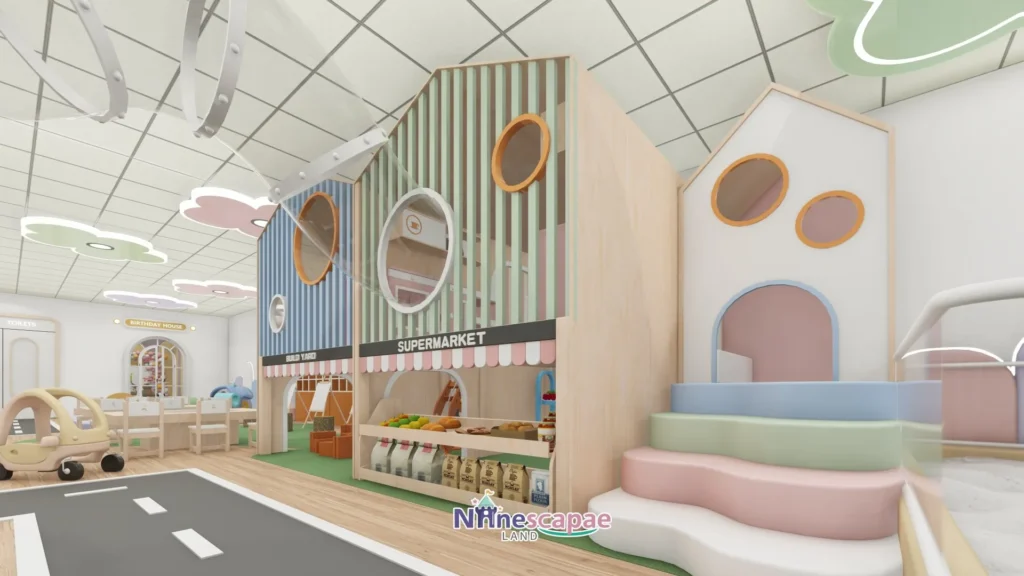
420㎡, Moldova
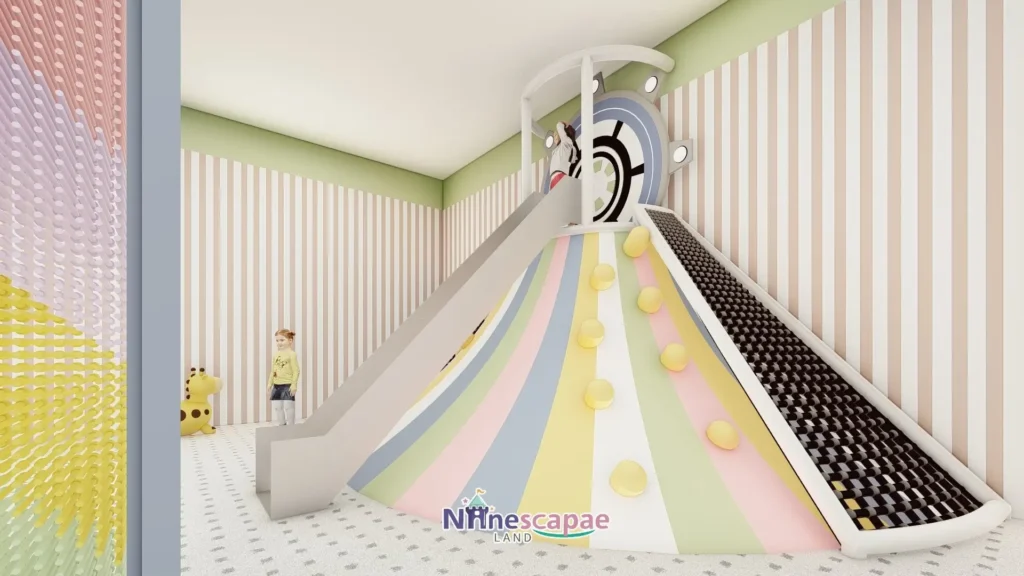
800㎡, Chile
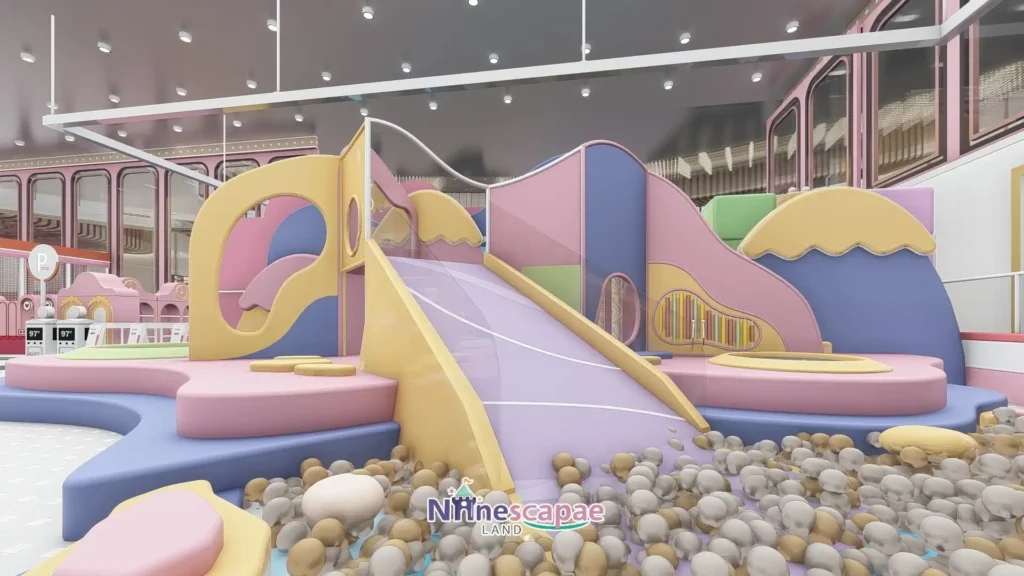
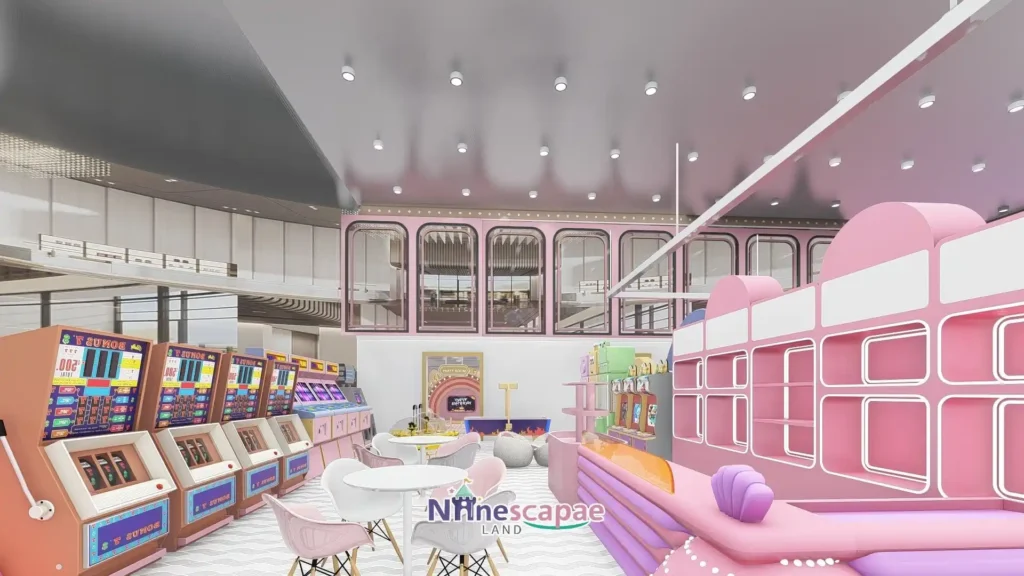
One honest note: not every large venue should be a hybrid. The 1,300㎡ Canada project sits at the other end of the range: it carries a jump zone alongside the soft-play structure, kept as a separate zone rather than one blended floor. Same size, different configuration — and both were the right answer for their catchment.
What to Ask a Supplier Before You Compare Two Quotes
An equipment quote shows one number. It does not show what the venue costs to keep running. Insurance, trained staff, replacement parts and inspection all sit outside that number. For a trampoline park they are materially higher than for a soft-play venue. These are procurement questions, not accounting ones — and the answers separate suppliers far more than price does.
Ask how the configuration affects insurance.
Underwriters price trampoline parks as high-risk amusement. Your broker will ask about jump-bed count, foam pit presence, zone separation and supervision ratio before quoting at all. A supplier who has delivered in your market can tell you what insurers typically ask for. One who cannot has probably never supported a claim.
Ask for the supervision plan, not just the equipment.
A soft-play venue runs on general attendants. A trampoline park needs trained court monitors enforcing age separation, one-person-per-bed, no double bouncing. Ask what monitor training, signage and operating manuals are included. If the answer is “the equipment only,” add that cost yourself.
Ask about first-aid and incident provisions.
Trampoline venues are usually expected to have trained first-aid cover during operating hours. Certification and staffing are recurring costs.
Ask for component service life in writing.
Trampoline beds, springs or tension systems, edge padding and nets are wear items on a replacement cycle. Soft-play padding, netting and slide surfaces degrade more slowly. Ask for expected service life per component and a spare-parts list. A supplier who answers this has sold into mature markets.
Ask about inspection intervals and checklists.
Both formats need documented daily opening checks and periodic professional inspection. The trampoline format needs more, because more of its risk sits in high-force components. The supplier should hand over a checklist template, not just equipment.
Ask whether the design can be serviced.
A layout with inaccessible service points costs money every time a part is replaced. Serviceability is decided at design stage once, and paid for over a decade.
Before You Choose: What NinescapeLand Needs From You
The whole decision comes down to six inputs. Without them, any comparison is guesswork — including ours.
| Input | Why it changes the answer |
| Floor area (㎡ or sq ft) | Decides whether a trampoline park is even possible |
| Clear ceiling height | Rules formats in or out before any design work |
| Location and target market | Sets the age profile and the compliance regime |
| Intended mix | Playground, trampoline, or hybrid |
| Budget range | Determines scope, not quality of structure |
| Target opening date | Drives production, shipping and installation sequencing |
Why operators work with NinescapeLand
Factory-direct since 2008. NinescapeLand manufactures in its own 50,000㎡ facility in Wenzhou, Zhejiang — not through a trading company. 2,000+ delivered projects across 75+ countries, from compact mall units to 1,300㎡ family entertainment centres.
Design before commitment. A free 3D layout preview shows how the space performs before you sign anything. NinescapeLand’s team reviews floor plans at planning stage, which is when layout and safety issues are still cheap to fix.
Certification for your market. Equipment built in conformity with ASTM F1918 / F1487, EN 1176 & 1177 and CE requirements, with TÜV-tested structures. Fire performance to EN 13501-1, NFPA 701, UL 94 and ASTM E1354. Documentation available on request for authorities, landlords and insurers.
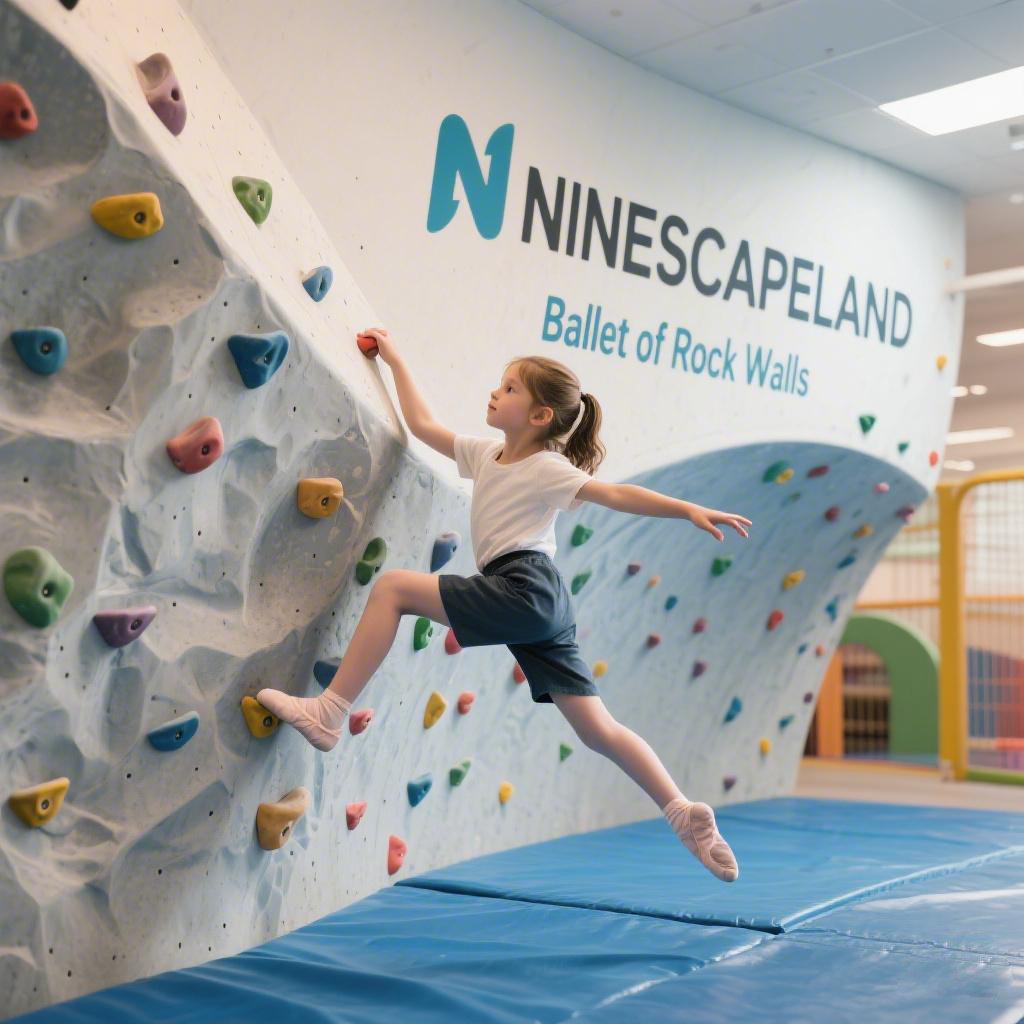
Full attraction range under one contract. Commercial indoor playground equipment, commercial trampoline parks, soft play, ninja obstacle courses and climbing walls. One commercial indoor playground manufacturer means one interface for zoning, safety clearances and installation sequencing — instead of three suppliers blaming each other.
Support after handover. 3-year warranty on steel structures, 1-year warranty on soft-play components, lifetime technical support, and spare parts for manufacturing defects. Installation scope matched to the contract, from technical supervision to full handover.

Next step
NinescapeLand does not publish a price list because no two venues are the same. Every quote starts from your actual floor plan. Send the six inputs listed above. The design team returns a layout proposal with a line-item equipment budget.
Free 3D layout preview included.
[WhatsApp: +86 150 5878 2901]
FAQ
Indoor playground vs trampoline park — which is better?
Neither is better in general. Below roughly 300㎡ with 3.5–5m clear height, an indoor playground is usually the practical choice. Above roughly 800㎡ with 5m+ clearance, a trampoline park earns more per visitor. Between 300 and 800㎡, a hybrid usually beats either format alone.
Can you combine an indoor playground and a trampoline park in one venue?
Yes, and for most mid-size venues it is the stronger model. The working layout separates three zones: toddler soft play, an open jump arena, and challenge elements such as ninja or climbing. Age bands are physically separated, with one entry point and one exit.
What ceiling height does a trampoline park need?
5 – 8m clear height is the practical range. 5m is the floor; 6 – 8m is preferred. Below 5m you lose safe jump trajectories, wall features and supervision sightlines. An indoor playground typically works from 3.5m upward.
How much space do I need for each format?
NinescapeLand’s indoor playground projects range from 15㎡ to 1,300㎡, with most commercial installations between 100㎡ and 800㎡, and 800㎡ – 1,300㎡ for hybrid FECs that combine soft play with a jump zone. Trampoline parks generally need 300㎡ minimum for timed sessions to work, and 800㎡+ for a full-scale park.
Which one is more profitable?
They profit differently. An indoor playground produces steadier, more frequent revenue from families and parties, with lower insurance and simpler staffing. A trampoline park has a higher revenue ceiling per visitor but depends more on weekends. That is exactly why the hybrid exists.
Do I need different certifications for each format?
Yes. In North America the reference standards are ASTM F1918 for soft contained play equipment and F1487 for playground equipment. In Europe, EN 1176 and EN 1177 cover playground equipment and impact-absorbing surfacing, with EN 1176-10 addressing fully enclosed play. CE marking applies for the EU, and fire performance is commonly tested to EN 13501-1 or NFPA 701. Requirements vary by country and insurer.
How long does a project take from order to opening?
It depends on design complexity, customisation and destination. Standard configurations move faster than fully themed builds. Ocean freight and installation add predictable but non-trivial time. Fix the opening date first, then work backwards through installation, shipping, production and design.
What information do I need to give for a quote?
Six inputs: floor area, clear ceiling height, location and target market, intended attraction mix, budget range, and target opening date.