
Quick Answer
Building a trampoline park from scratch typically costs $300,000 to $1,200,000 — but that figure includes venue fit-out, rent, and engineering.
The equipment itself (where most buyers start) ranges from around $30,000 for a compact setup to $86,000+ for a large custom project.
This guide breaks down every line item and explains which number actually applies to your project.
1. Which “Trampoline Park Cost” Are You Actually Asking About?
When most buyers search for how much do trampoline parks cost, they are really asking three completely different questions. Confusing them is the number-one reason quotes seem to contradict each other.
Before we explain, here’s a table you’ve probably seen before:
| Park Size | Area | Estimated Total Investment |
| Small / Boutique | 200–500 sqm | $50,000 – $130,000 |
| Medium / Suburban | 500–1,500 sqm | $130,000 – $500,000 |
| Large Commercial / High-End | 1,500–3,000+ sqm | $500,000 – $1,500,000+ |
This table isn’t wrong — but it shows the full turnkey cost, including fit-out, rent, and engineering.
If you only purchase equipment, the numbers for the same area are much smaller. This is why “how much does a trampoline park cost” produces so many conflicting answers — people simply aren’t talking about the same thing.
The Three Cost Scopes
| Scope | What It Covers | Typical Range |
| Full Turnkey Cost | Everything from empty space to opening day: equipment + fit-out + HVAC + fire systems + rent deposit + engineering + marketing | $300,000 – $1,200,000+ |
| Landed Equipment Cost | Equipment + international freight + duties + customs clearance | Equipment price +15%–30% |
| Ex-Works Equipment Price | Equipment only, excluding freight and duties | $30,000 – $86,520 (our packages) |
How much does it cost to start a trampoline park?
Short answer: $300,000 to $1,200,000+, depending on venue size, location, and attraction mix.
The range is wide because it covers everything from site selection and fit-out to opening-day marketing. If you look at equipment alone, the number is far smaller — typically 40%–60% of the total.
For first-time investors, we generally recommend preparing 1.1–1.15× your total budget to cover adjustments during construction and equipment installation.
2. Total Project Cost: The Big Picture
Understanding how a full project budget breaks down is the first step in judging whether your budget is realistic.
Cost Components and Their Share
| Cost Item | Share of Total | Notes |
| Equipment package | 40%–60% | The largest single item — and the only one you can meaningfully compress |
| Venue fit-out & construction | 15%–25% | Flooring, walls, HVAC, lighting, fire systems |
| Rent & deposit | Varies by region | Usually accounted for separately |
| Freight, duties & installation | 8%–15% | Huge variation on imported projects |
| Permits & insurance | 3%–8% | Varies by country and city |
| Pre-opening marketing & working capital | 5%–10% | The most commonly overlooked item |
How much does it cost to build a trampoline park?
Short answer: equipment accounts for 40%–60%; the rest is venue engineering, rent, permits, and working capital.
For a standard 800–1,000 sqm venue, the full project budget typically falls in the $300,000–$700,000 range (excluding property purchase). Within that:
- Equipment package — the largest single outlay, and the most flexible
- Venue engineering — a fixed cost; insufficient ceiling height significantly raises renovation costs
- Working capital — we recommend reserving 3–6 months of operating expenses
How much does it cost to open a trampoline park?
Short answer: it depends on whether you choose “equipment only” or “full turnkey”.
- Equipment only — your investment concentrates on the equipment package; everything else you organize yourself
- Full turnkey — the supplier handles everything from design to installation; higher upfront budget, but far less project management burden
The difference isn’t just money — it’s how risk and responsibility are allocated, which we cover in the next section.
3. How Is a Trampoline Park Quote Structured?
This section answers the two questions buyers ask most: “What exactly does this price include?” and “Which purchasing model should I choose?”
A. What Is Typically Included in a Quote?
| Item | Usually Included? | Notes |
|---|---|---|
| Trampoline frames, mats and springs | ✅ Yes | Core jumping system |
| Foam pits, padding, safety nets and mats | ✅ Yes | Specify materials and thickness |
| Ninja/climbing / airbag / interactive modules | ⚪ Optional | Depends on attraction mix |
| 3D design and layout | ✅ Yes (free) | Confirm whether revisions are included |
| Production and factory inspection | ✅ Yes | Ask for material lists and QC process |
| International freight | ⚠️ Depends on terms | Confirm EXW / FOB / CIF / DDP |
| Import duties and local taxes | ❌ Usually not | Paid by buyer per destination country |
| On-site installation and commissioning | ⚪ Optional | Confirm supervisor-only vs full installation team |
| Venue fit-out, HVAC, fire compliance | ❌ No | Typically handled by a local general contractor |
Key insight: the landed cost of imported equipment is typically 15%–30% higher than the equipment quote — freight, duties, and installation are all add-ons. This is why “equipment price” and “final spend” never seem to match.
On trampoline assembly and installation cost
Installation typically accounts for 5%–10% of the equipment total, depending on:
- Installation scope — remote guidance < on-site supervisor < full installation team
- Site conditions — ceiling height, floor flatness, electrical configuration
- Timeline pressure — rushed schedules drive up labor and travel costs
A 1,000 sqm venue usually takes 5–10 days with 4–6 technicians to install; large parks may take up to 20 days.
On regional compliance (EU / Europe)
Installation and delivery scope vary by region. For trampoline park equipment in the EU and Europe, additional local compliance checks and safety certifications apply — an item easily overlooked in a quote.
B. Equipment-Only vs Turnkey
| Aspect | Equipment-Only | Turnkey |
| Main scope | Trampoline and attraction equipment | Design + equipment + production + shipping + installation support |
| Buyer handles | Local construction, fit-out, permits, installation labor | Fewer suppliers, but local compliance is still yours |
| Best for | Buyers with local installation resources | First-time investors, overseas buyers, complex multi-zone projects |
| Quotation basis | Equipment list and configuration | Site drawings, ceiling height, country, attraction mix, delivery scope |
| Typical risk | Installation quality and project coordination | Higher upfront budget, but clearer project management |
How to choose?
- You have a reliable local contractor familiar with local acceptance standards → equipment-only works
- You’re a first-time operator, or based overseas and coordinating multiple suppliers is burdensome → choose turnkey
- Your project is multi-zone or multi-phase → turnkey significantly reduces coordination overhead
In short: equipment-only saves upfront budget; turnkey saves effort and risk.
4. 7 Factors That Change Your Quote
Two buyers with the same brief can receive very different quotes. Each of these 7 factors directly changes the final number.
1. Site Area and Ceiling Height
- Area determines how much equipment fits; ceiling height determines which equipment fits
- Ceiling height below 5 m immediately rules out ninja courses, climbing walls, airbags, and other attractions
- Renovation difficulty (floor load capacity, fire rating) significantly affects venue engineering cost
2. Attraction Mix
This is where the widest price variance comes from:
- Trampoline zone only — base investment
- Trampoline + foam pit + basketball/dodgeball — mid-range
- Trampoline + ninja course + climbing + airbag + interactive AR — can reach 2–3× a trampoline-only solution
3. Customization Level
- Standard colors, standard layout → lowest cost
- Themed design, custom colors, logos, lighting systems, non-standard structures → higher design and manufacturing cost
4. Safety Configuration
- Padding thickness, net density, cushioning material grade
- Whether it meets ASTM / EN and other international certifications
- We don’t recommend cutting this — it directly affects insurance costs and long-term liability risk
5. Destination Country
- Shipping distance and routes, duty rates, customs efficiency
- Inland transport and on-site installation travel costs
- The same equipment can land at a very different cost in Europe versus the Middle East
6. Installation Scope
| Option | Cost | Notes |
| Remote guidance | Lowest | We provide drawings and video; you install |
| On-site supervisor | Moderate | 1–2 technicians on site |
| Full installation team | Highest | 4–6 person team end-to-end |
7. Project Timeline
- Normal scheduling vs expedited scheduling affects production and logistics cost
- A rushed timeline may require air freight or expedited sea freight, sharply increasing shipping cost
The takeaway: five buyers with the same floor plan can receive five different quotes — and all five can be correct.
5. Our Real Equipment Price Range
The above covers the industry picture. Now let’s talk about how we actually quote.
Price Distribution
| Price Range | Notes |
| Under $45,000 | Entry-level packages cluster here |
| $45,000 – $65,000 | Our mainline packages cluster here |
| Above $65,000 | Large/high-end custom projects |
Real Package References (With Area)
| Package | Area | Price |
| Compact Trampoline Park & Playground Equipment Package | 200 sqm | $69,000 |
| 500 Square Meter Trampoline Park Supplier | 500 sqm | $86,520 |
| Indoor Trampoline Park For Children | ~743 sqm (8,000 sq ft) | $51,000 |
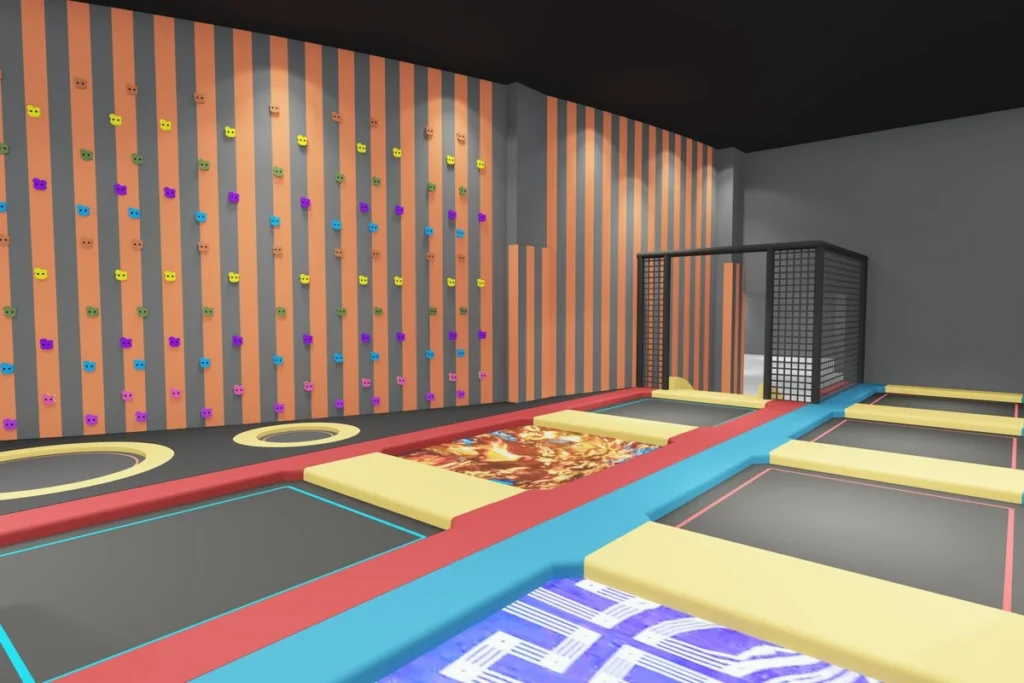
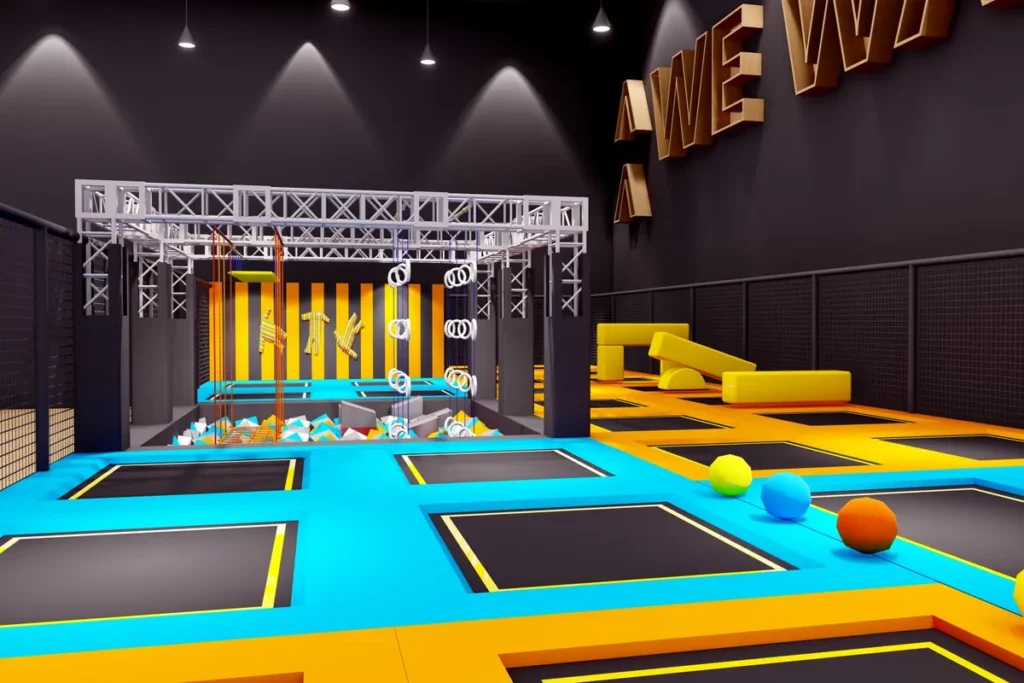
Note: These are real catalog prices. Look at the last two rows — the ~743 sqm package ($51,000) is actually cheaper than the 200 sqm package ($69,000). The reason is simple: the first is a trampoline-only configuration, while the second includes foam pits, a basketball zone, and multiple other modules. Area only determines how much you can fit; configuration determines how much you’ll spend.
6. Real Projects We’ve Delivered Worldwide
Rather than vague “a client in Southeast Asia” case studies, we’d rather list exactly what we’ve built.
| Project | Location | Area | Completed |
| Trampoline Park USA | Los Angeles, California | 450 sqm | 2024 |
| Trampoline Park Canada | Ontario, Canada | 1,200 sqm | 2023 |
| Trampoline Park Australia | Sydney, NSW | 680 sqm | 2024 |
| Trampoline Park UK | Manchester, UK | 900 sqm | 2025 |
| Trampoline Park UAE | Abu Dhabi, UAE | 780 sqm | 2024 |
- 2,000+ projects delivered worldwide
- ASTM & EN certified, lifetime frame warranty
- Free custom 3D design, factory-direct pricing, professional installation team
From a 15 sqm community venue to a 1,300+ sqm entertainment center — we’ve built both. That’s why we can say with confidence: there is no single unit price.
7. From the World’s Biggest Parks to Yours
After going through the costs, many buyers get curious: how big is the world’s biggest trampoline park, and what did it cost?
- The world’s biggest trampoline park spans tens of thousands of square meters — an investment scale far beyond most investors’ budgets
- But the largest trampoline park in your region is often just a few hundred to a few thousand square meters — very close to what you’re planning
The point isn’t to chase scale — it’s to match your market.
A well-configured 500 sqm venue serving a 3–5 km radius of local families often delivers a better return than a larger park that tries to do everything.
Want to know how big your site should be, and which attractions to include? That’s exactly what our free 3D design service is for.
8. 5 Ways to Reduce Cost Without Cutting Safety
1. Buy Factory-Direct
Going through middlemen typically adds 20%–30% in cost. Factory-direct supply is the most direct saving available.
2. Build in Phases
Open a core zone first (trampolines + foam pit), then expand using revenue from operations. This is common practice among successful venues — you don’t need to build it all on day one.
3. Optimize Container Planning
Smart packing layouts reduce the number of containers, which meaningfully lowers freight cost.
4. Combine Standard and Custom Components
Use proven solutions for load-bearing structures and standard parts, and customize only the visual and experiential elements — balancing cost and differentiation.
5. Choose Energy-Efficient Equipment
Energy-efficient lighting and high-performance HVAC can cut electricity costs by 20%–30% — the biggest long-term saving available.
Not sure how to configure it most cost-effectively? Send us your floor plan and we’ll work out a phased-investment plan that minimizes your upfront spend.
9. How to Get an Accurate Quote
What You’ll Need to Prepare
- Site area, dimensions, and ceiling height
- Site floor plan or CAD drawing
- Target customer profile and expected footfall
- Budget range
- Destination country / city
- Whether you need ninja courses, climbing walls, airbags, or interactive equipment
- Whether you need 3D design, freight, installation, or full turnkey support
- Target opening date
Get Started
As an experienced Commercial Indoor Playground Equipment Manufacturer, NinescapeLand supports projects from concept to opening day.
Start your trampoline park project with NinescapeLand — get all three of the following:
- Get a Free 3D Trampoline Park Design
- Request an Itemized Equipment Quote
- Send Us Your Site Drawing for a Custom Proposal
10. Frequently Asked Questions (FAQ)
Q1. How much do trampoline parks cost?
Building from scratch typically costs 300,000–1,200,000+ including fit-out, rent, and engineering. Equipment alone ranges from $30,000 to $86,520. The exact figure depends on venue area, ceiling height, attraction mix, and delivery scope.
Q2. How much does it cost to build a trampoline park?
Equipment accounts for roughly 40%–60% of the total; the rest is venue engineering, permits, insurance, and working capital. Full project budgets vary widely with area, ceiling height, and configuration — we recommend an assessment based on your actual floor plan rather than a one-size-fits-all number.
Q3. How much does it cost to open a trampoline park?
It depends on the purchasing model. With equipment-only, investment concentrates on the equipment package. With full turnkey, the supplier handles everything from design to installation — a higher upfront budget but less management burden.
Q4. How much would it cost to open a trampoline park?
Broadly the same range — 300,000-1,200,000. We suggest preparing 1.1–1.15× your budget to cover construction and equipment adjustments.
Q5. What is the average cost per square foot?
It’s difficult to give a single unit price. Differences in equipment configuration, ceiling height, and attraction mix can multiply the cost per square meter. For the same area, a trampoline-only layout and a full attraction mix can have completely different unit costs. Always work from a specific configuration list.
Q6. How much space and ceiling height do I need?
We suggest a minimum of 200 sqm, with mainstream packages at 500–1,000 sqm. Ceiling height should be at least 5 m; below that, ninja courses, climbing walls, and similar attractions are restricted. Smaller spaces work too — NinescapeLand has delivered compact trampoline and soft play installations from as little as 15 sqm, so if your venue is tight, send us the dimensions and we will design around them.
Q7. How long do production and installation take?
Production typically takes 30–45 days for trampoline parks; sea freight typically adds 20–40 days depending on destination. On-site installation takes about 5–10 days for standard projects (4–6 technicians), with large projects up to 20 days. Total lead time from first inquiry to completed installation is usually about 2–3 months for standard projects, and up to 4 months for large parks or distant destinations.
Q8. What certifications should the equipment meet?
We recommend ASTM F2970 (trampoline court safety) and EN 13219 (trampoline equipment), among other international standards. These directly affect insurance cost and compliance risk.
Q9. Do you provide installation services?
Yes. We offer three options — remote guidance, on-site supervision, or a full installation team — depending on your site conditions and budget.
Q10. Can you customize the layout?
Yes. We provide free custom 3D design, tailored to your venue dimensions, ceiling height, target customers, and budget.
Q11. Is a trampoline park profitable?
Yes. Industry data shows average annual revenue per venue of around $2 million (US market). Most parks break even within 3–5 years.
Q12. How long does it take to break even?
Typically 3–5 years, depending on ticket price, footfall, operating costs, and local competition.
Sources: Industry-wide ranges are based on publicly available industry data. Equipment prices come from NinescapeLand’s 2,000+ delivered projects worldwide and current catalog.